

Beginner’s Guide to Fiber Laser Cutting Machines: Sheet vs Tube
Time : Feb 05, 2026 Просмотр : 312
In recent years, fiber laser cutting has turned into a key method in today’s metal working. It changes the way makers handle accuracy, speed, and adaptable output. For those just starting out in this area, grasping the basic contrasts between sheet and tube fiber laser cutting machines matters a lot. This knowledge helps them pick the right gear wisely. Each kind of machine follows unique working methods, use cases, and material shapes. These factors affect output speed, expense management, and growth over time. This overview lays out fiber laser cutting basics. It also gives a straightforward side-by-side look at sheet and tube setups. In this way, new users can match their machine choice to real workshop demands and plans for the future.
In this fast-changing world of making things, choosing gear goes beyond just specs. It involves the trustworthiness of the supplier too. That’s why Висекут comes up in the talk. The company stresses fiber laser cutting options for sheet metal and tube jobs alike. Wisecut blends solid design work, routine building processes, and down-to-earth ideas that fit actual shop setups. Its machines rely on steady laser units, tough frames, and easy-to-use controls. Because of this, beginners can get reliable cut results without a steep training period. Wisecut backs this with full training sessions, quick worldwide support, and a range of products. These include single-platform, tube-only, and combined sheet-and-tube models. Overall, Wisecut provides a steady starting option for makers. It also leaves space for later growth.
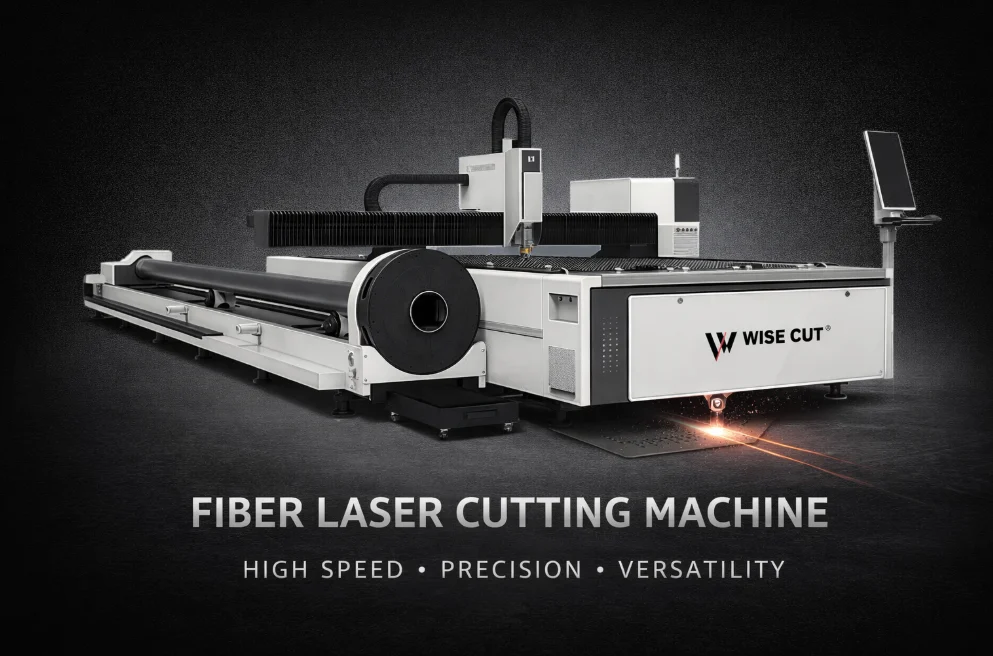
Basics of Fiber Laser Cutting Machines for Metal Fabrication Beginners?
Selecting your initial equipment begins with understanding the laser head’s function. Fiber laser technology employs an optical fiber to produce a focused beam. This beam cuts through metal with remarkable accuracy. It represents a significant improvement over conventional mechanical tools or plasma cutters. Those older methods typically result in uneven edges.
Core working principle of fiber laser technology
The operation relies on a fiber laser source, such as the 3000W single module CW fiber laser. This source provides strong electro-optical conversion efficiency along with an extended lifespan. The beam passes through lenses for concentration. It then melts or vaporizes the metal. Meanwhile, a high-pressure gas, often nitrogen or argon, removes the molten residue to form a neat cut. Since it avoids physical contact, concerns about tool degradation or distortion in delicate components disappear.
Materials commonly processed: carbon steel, stainless steel, aluminum, copper
These systems process a wide array of metals. Examples include carbon steel, stainless steel, aluminum alloy, brass, copper, and titanium. For those new to the process, this adaptability proves highly beneficial. The equipment manages everything from 0.5mm thin sheets to 25mm thick carbon steel plates without issues.
Why fiber lasers are ideal for beginners: efficiency, precision, low maintenance
Maintenance often poses a major challenge in workshops. Fiber lasers demand far less upkeep than CO2 lasers. Additionally, they operate at impressive speeds. For instance, certain machine beds achieve travel rates up to 110m/min.
Why Fiber Laser Technology Is Replacing Traditional Cutting Methods?
If you still compare lasers to plasma or flame cutters, consider the overlooked expenses.The global fiber laser market was valued at USD 6.87 billion in 2024 and is projected to grow to USD 7.56 billion in 2025, reflecting increasing adoption in metal fabrication due to superior efficiency over traditional methods. Older techniques frequently necessitate extra steps. These might involve grinding or polishing due to rough or stained edges.
Comparison with plasma, flame, and mechanical cutting
Plasma suits thick materials needing basic accuracy. However, it falls short of the ±0.03mm positioning precision found in advanced fiber lasers.In 2024-2025 analyses, fiber lasers demonstrate up to 50% lower energy consumption compared to plasma systems for equivalent cuts, contributing to their growing preference in precision applications. Flame cutting generates a large heat-affected area. Recent industry demonstrations show that ultra-high-power fiber laser systems can reduce energy consumption by up to 50% compared to plasma cutting, while also lowering CO₂ emissions by up to 70% in industrial applications.This can alter the metal’s properties undesirably. Fiber lasers offer an intuitive user interface. The software handles complex tasks. Thus, the resulting welds or cuts appear smooth and require no further finishing.
Advantages in cutting speed, edge quality, automation compatibility
In this sector, speed directly translates to profitability. Fiber lasers perform quicker on thin and medium-thickness materials. For thinner sheets (e.g., under 1.25mm), fiber laser cutting can be nearly twice as fast as plasma cutting, while delivering superior edge quality that often requires no secondary processing.Moreover, the edges often emerge polished and shipment-ready straight from the machine. These devices also prepare for modern workflows. You can connect them to an automated sheet metal production unit. It incorporates robots and vacuum suction cups for material handling. This setup minimizes reliance on manual effort.
What Is a Sheet Metal Fiber Laser Cutting Machine?
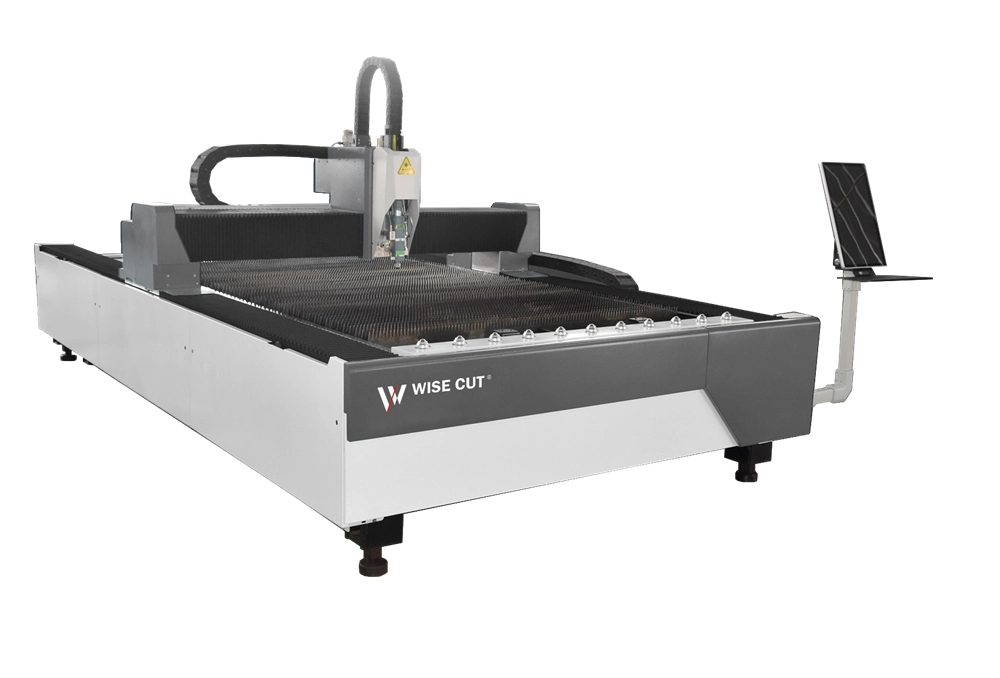
Many entrants begin with this type. A sheet metal machine includes a spacious flat bed for positioning metal plates. It serves as the backbone for sectors like elevator production, kitchen equipment, and signage creation.
Key characteristics of sheet metal laser cutting machines
Such devices employ a gantry framework to shift the laser head along the X and Y axes. The bed features a robust welded construction. Some versions use a honeycomb carbon layout that undergoes annealing to reduce internal tensions. Therefore, the unit remains steady and precise even after prolonged high-speed use and vibrations.
Recommended Машина для лазерной резки листа металла одной платформы
For novices with constrained workspace, this option stands out as practical. It delivers a compact design suitable for smaller facilities. Yet, it maintains substantial capability. Машина для лазерной резки листа металла одной платформы holds CE certification and emphasizes straightforward setup and upkeep. It provides a reliable, rapid method for producing items like brackets, panels, or flat decorative elements on a regular basis.
What Is a Tube Fiber Laser Cutting Machine?
As your operations shift toward furniture, bicycle frames, or building scaffolds, a standard flatbed proves inadequate. In such cases, a dedicated laser tube cutting machine becomes essential.
Core features of tube laser cutting machines
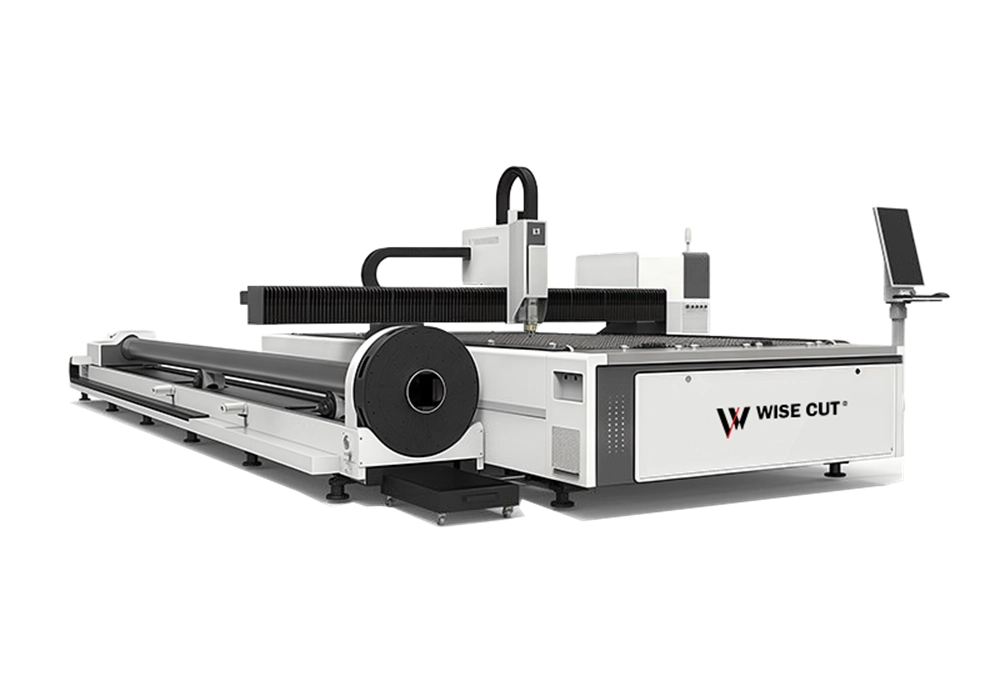
А fiber laser tube cutting machine utilizes a chuck mechanism to secure and rotate the pipe. The laser performs the cuts simultaneously. This setup enables intricate patterns like “fish-scale” designs or angled perforations that a flat surface cannot achieve. A CNC laser tube cutting machine processes round, square, and rectangular tubes effortlessly. It employs automatic alignment to ensure precise centering for every feature.
Тube laser cutting is the right choice for beginners
Consider a tube laser cutting machine manufacturer if structural frames dominate your tasks. Whether you act as a laser tube cutting machine supplier or manage a workshop, this equipment eliminates lengthy manual drilling and sawing. An automatic laser tube cutting machine advances efficiency by loading the subsequent pipe as the current one completes. This proves transformative for substantial output volumes.
To give you a better idea of what to expect, here are the real-world technical specifications for a popular entry-level professional model:
Пункт | Технический параметр |
Модель | WT-3015 |
Working Size | 1550 × 3050 mm |
X/Y Position Accuracy | ± 0.03 mm |
Z Position Accuracy | ± 0.008 mm |
Max No-Loading Running Speed | 100 м/мин |
Max Processing Thickness | 25 mm |
Table Max Loading Weight | 1 T |
Power Demand | 380 V / 50 Hz |
Вес машины | 2.2 T |
Sheet vs Tube Fiber Laser Cutting Machines: Key Differences Beginners Must Know?
The primary distinction goes beyond the metal’s form. It centers on how the device processes the material. Sheet machines guide the head over a fixed plate. In contrast, a laser pipe cutting machine rotates the workpiece while the head travels its length.
Production efficiency and application scenarios
For large-scale flat component production, the sheet model excels. On the other hand, an industrial laser tube cutting machine shines in streamlined operations. It trims the tube to size and adds notches plus openings in a single pass.
Why a Лист & Машина для лазерной резки металлического волокна Makes Sense?
Newcomers frequently face uncertainty about future client needs. A combined unit serves as a reliable safeguard for your purchase.
Hybrid sheet and tube laser cutting technology
Лист & Машина для лазерной резки металлического волокна basically combines a solid sheet cutting platform with an added rotary axis on the side. Users can transition from processing a 3000mm x 1500mm plate to a 6-meter pipe within moments. It conserves valuable space. You avoid installing two distinct lengthy machines.
Ideal for beginners expanding product lines
Opting for this integrated approach cuts down on staffing requirements and individual service routines. It delivers consistent support features like remote troubleshooting.
How Beginners Can Choose the Right Fiber Laser Cutting Machine?
Key factors to evaluate before buying
Assess your facility’s power setup initially. Most units demand a 380V connection. Also, examine the table’s “Max Loading Weight.” A 1-ton limit serves as a common benchmark for sheet models. When eyeing a tube laser cutting machine, inquire with the laser tube cutting machine manufacturer regarding the chuck’s largest supported diameter.
How Wisecut Laser supports beginners
Partnering with a company that delivers “free training to the machine operators” until they master programming and care proves crucial. Seek providers offering “Fast 24/7 remote diagnostics” plus “on-site engineer support within 48 hours globally.”
Real Application Scenarios Using Modern Fiber Laser Systems
Across Europe, certain distributors have acquired more than 50 units. They value the ability to adjust power and velocity for targeted outcomes. One customer specified a tailored color coating to align with their branding. The delivery arrived in merely two weeks.
Case examples: panels vs frames
In practical settings, a sheet machine supports components for rail transit or farm machinery. A versatile sheet and tube unit, however, might produce exterior panels for a food processor alongside its supporting tubular structure. All this occurs in one session.
Conclusion: Choosing the Right Fiber Laser Cutting Machine as a Beginner
Industry projections show continued strong growth, with the global fiber laser market expected to expand at a CAGR of around 10-11% through the late 2020s, driven by adoption in metal fabrication.
The optimal device does not equate to the priciest option. Instead, it aligns with your specific processes. If plates dominate your workspace, select a single platform sheet cutter. For structural endeavors, target a tube laser cutting machine. Yet, to prepare for diverse demands, the hybrid sheet and tube variant offers the wisest direction. Explore the complete selection of products for insights. Alternatively, contact the team for personalized guidance.
Часто задаваемые вопросы
Q1: What is the main difference between sheet and tube laser cutting?
A: Sheet machines employ a flat bed for metal plates, whereas tube machines utilize a rotary chuck to spin pipes and profiles for cuts at multiple angles.
Q2: Can a sheet laser cutting machine cut tubes?
A: Generally not, except in hybrid “Sheet & Tube” configurations that feature a side rotary axis built for pipes.
Q3: How much power does a beginner need for a fiber laser?
A: A 3000W laser serves as a favored balance. It processes 0.5mm to 20mm stainless steel effectively and maintains reliability over extended periods.
Q4: What kind of maintenance do these machines require?
A: Primarily, clean the lenses, oversee the chiller’s water level and temperature, and verify the purity of the gas supply.


