

Full Enclosed Fiber Laser Cutting Machine: Is It Worth Buying?
Time : Nov 06, 2026 Vue : 273
A full enclosure can be worth the added project cost when it addresses a documented need for beam containment, work-area separation, process capture, or a more controlled production layout. It is not an automatic upgrade for every shop. A Fiber Laser Cutting Machine still needs a suitable safety design, extraction plan, loading method, service access, and documentation for its intended use. The enclosure alone does not prove that those elements are adequate. Compare the complete machine cell against your job mix, facility, and operating procedures before choosing.
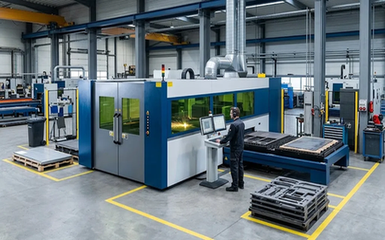
Quick verdict: when a full enclosure is worth considering
A full enclosure deserves consideration when the shop needs a defined cutting cell, separation from nearby work, or a repeatable layout. It may also suit a line with automated loading. These are reasons to evaluate a configuration, not guarantees of better output. Compare each fiber laser cutting machine as a complete cell, including its safeguards and extraction plan.
An open table may suit shops handling awkward sheets, relying on overhead crane access, or needing loading from several sides. The right choice depends on the risk assessment and operating plan for the machine and location.
Use a simple decision rule: define the problem first, then ask whether the quoted enclosure and safeguards solve it. If the business case is only “enclosed sounds safer,” request the machine-specific evidence before paying for the option.
What a full enclosure changes—and what it does not
Beam access, guarding and interlocks
A complete enclosure can form part of a laser hazard-control strategy by restricting access to the processing area during operation. Doors, viewing panels, interlocks, emergency stops, warning indicators, and service modes must work together as specified. Their design and performance matter more than the label “full cover.” OSHA’s laser hazard-control guidance discusses engineering controls such as enclosures and interlocks. Treat it as a review prompt, not a machine approval or a substitute for the rules that apply at your facility.
Ask the supplier to identify which safeguards are included, how access is controlled during cutting, and what happens if a door opens or an interlock faults. Also review how technicians isolate energy and access the cutting head during maintenance. Never assume that a viewing window, cover, or marketing description establishes a particular laser classification.
Fume extraction and process containment
An enclosure does not remove the need to evaluate fumes, dust, and extraction. Cutting conditions and materials affect what the process produces; the collection system must be designed and maintained for the actual application. OSHA’s Technical Manual chapter on laser hazards describes ventilation as a control consideration for laser operations. Confirm the extraction interface, required airflow and filtration scope with qualified professionals, and verify how the setup will perform in your facility.
What the enclosure cannot prove
A cover by itself does not establish regulatory compliance, machine classification, cut quality, cycle time, extraction effectiveness, or operator competence. Those conclusions require machine-specific records, applicable standards, risk assessment, and acceptance checks. For example, IEC 60825-1 addresses laser-product safety and classification; reference to the standard is not proof that a particular machine has been assessed or conforms.
The main benefits of an enclosed fiber laser cutting machine
A defined cutting cell and operator workflow
A defined cell helps teams plan material loading, monitoring, part removal, and routine checks. Evaluate it with the loading sequence, not as an isolated shell.
Separation from nearby work areas
A barrier can separate the cutting zone from adjacent work areas and help organize traffic. It does not replace access controls, training, signage, maintenance procedures, or local review.
Fit with repeat production or automation
An enclosed layout may suit a cell with exchange tables, automated loading, or downstream handling. Review the complete layout, including guards around connected equipment and access during normal operation, setup, and fault recovery.
The trade-offs buyers should price in
The quote is only one part of the project. Compare enclosure, loading method, extraction, utilities, freight, rigging, installation, commissioning, training, maintenance access, and spare parts. Mark which items are included, optional, or supplied by others.
Measure the footprint and working envelope, including doors, service panels, extraction ducting, material staging, and access. Confirm the delivery route, door height, turning radius, floor capacity, and overhead clearance before installation.
For loading, consider sheet size and weight, crane or forklift access, exchange-table movement, operator reach, and finished-part handling. Ask for a complete process layout, not just the machine outline.
Finally, check whether technicians can reach key components without removing major structures. Get the routine cleaning tasks, maintenance intervals, and service procedures in writing for the quoted configuration.
Open table vs. full enclosure: compare the whole workflow
|
Shop requirement |
Open table may fit when… |
Full enclosure may fit when… |
|---|---|---|
|
Loading |
Frequent crane access from several sides is essential |
The planned loading path works through defined openings or automation |
|
Work area |
Open access supports the current floor plan |
A separated, organized cutting cell solves a real layout need |
|
Production |
Jobs vary widely in size and setup |
Repeated jobs benefit from a consistent cell workflow |
|
Safety review |
A site-specific assessment supports the chosen safeguards |
The enclosure and interlocks are documented for the intended process |
|
Extraction |
The extraction design works for the chosen open configuration |
The enclosure is integrated with a verified extraction plan |
|
Le service |
Unrestricted access is a priority |
Service panels and procedures preserve practical maintenance access |
This is a screening tool, not a substitute for a risk assessment or engineered layout. Match the machine to the parts you cut, how often jobs change, the number of operators, material handling equipment, and available floor space. If several requirements conflict, ask suppliers to quote comparable configurations and document what changes in the scope.
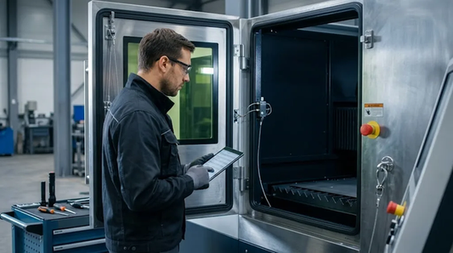
How to verify the enclosure before ordering
Request the exact configuration and its laser classification, test or conformity records, safeguard details, interlock logic, emergency-stop arrangement, and operating instructions. Confirm that documents cover the offered options and process. ISO 11553-1 addresses laser-processing-machine safety; verify applicable editions and jurisdictional requirements.
Ask what happens when a door opens, how faults appear, and how the system behaves after power loss or restart. Clarify service-mode safeguards, then have a qualified safety professional review the design for the destination and application.
Verify extraction responsibility, utilities, dimensions, anchoring, lifting points, and clearance. Agree on written acceptance tests and pass conditions before shipment, including safety-device checks, sample parts, and training where relevant.
RFQ checklist: questions to ask every supplier
Include these questions in the request for quotation:
What exactly is included in the enclosure, doors, viewing panels, interlocks, warnings, and emergency stops?
Which machine-specific classification and safety documents will be supplied, and who verifies destination requirements?
What extraction connection, fan, filter, ducting, or facility work is included or excluded?
How are sheets loaded and unloaded? Is an exchange table or automation part of the quote?
What footprint, access clearance, floor, power, and utility conditions must the site meet?
Which maintenance tasks require access inside the enclosure, and what isolation procedure applies?
What commissioning, operator training, acceptance tests, warranty, and service response are included?
Which items are supplied by the buyer or a local contractor, and what could delay installation?
Request a line-item quote and site layout with exclusions marked. Buyers reviewing a fiber laser cutting machine category ou full-enclosed configuration should verify claims against the specific proposal. Request current documents through the supplier’s page de contact.
FAQ: enclosed fiber laser cutting machines
Does a full enclosure improve cut quality?
Not by itself. Cut quality depends on the specified machine, process settings, material, consumables, and operating conditions. An enclosure may change access and process layout, but it is not evidence of tighter tolerances or better edges. Ask for sample cuts and acceptance criteria using your material, thickness, geometry, and inspection method.
Does an enclosure remove the need for fume extraction?
No. The enclosure and extraction system serve different functions and must be considered together. Confirm what the process generates, how fumes and dust are collected, what filtration is included, and who designs and verifies the installation. Do not treat a closed housing as proof that airborne contaminants are controlled.
Does “enclosed” automatically mean a particular laser class?
No. Classification depends on the machine’s design and assessment, not the product label alone. Request records for the exact configuration and have the applicable requirements checked for the intended location and use. A standard name in a quotation is not a substitute for machine-specific evidence.
Is an enclosed machine harder to maintain?
It can change how technicians access components, but the effect depends on the design. Review service-panel locations, routine cleaning steps, isolation procedures, and the space needed for repairs before ordering. Ask the supplier to demonstrate the maintenance sequence and identify any task that requires special tools or extended downtime.
Final decision: buy the enclosure that solves a verified need
A full enclosure is worth considering when its documented safeguards, extraction integration, work-area separation, and production layout solve needs your shop has actually identified. It may be a poor fit when loading access, floor space, or service clearance conflict with the way you work. Compare complete project scope, verify machine-specific documents, and assess the proposed layout before you decide. Choose the configuration that fits the risk assessment and workflow—not the one with the strongest label.


