

Laser Cleaning Machine Guide for Rust, Paint and Surface Treatment
Time : Aug 28, 2026 View : 270
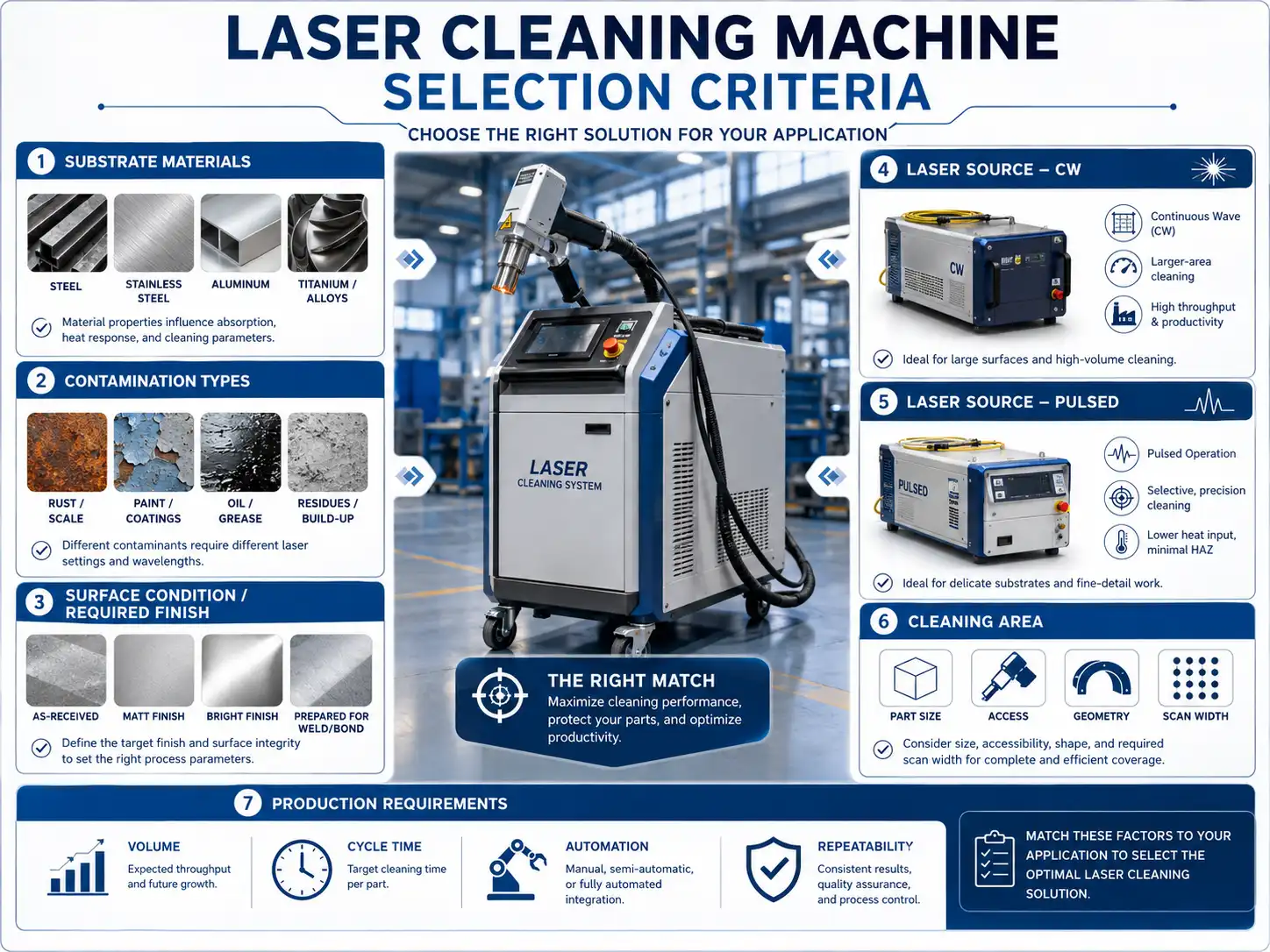
A laser cleaning machine removes surface contamination with controlled laser energy. The right configuration depends on six inputs: contaminant, substrate, allowable surface change, cleaning area, required cleaning rate, and production format. Start with the part and its acceptance standard. Then compare continuous-wave (CW) and pulsed sources, handheld and automated delivery, extraction, safety controls, and supplier test evidence.
What Is a Laser Cleaning Machine and How Does It Work?
Laser Ablation and Contaminant Removal
Laser cleaning relies on the different ways a contaminant and its substrate absorb energy. A scanning head moves the beam across the surface. Absorbed energy heats, fractures, detaches, or vaporizes the target layer. The response changes with the material pair and process settings.
The Inputs That Control the Cleaning Result
Pulse energy, pulse width, frequency, scan pattern, spot overlap, travel speed, focus, and passes influence removal and heat input. Coating thickness, corrosion condition, substrate finish, and geometry also affect the result. Production settings need a recorded test on the exact part.
Which Laser Cleaning Machine Type Fits Your Application?
Continuous-Wave Laser Cleaning Machines
CW sources deliver a steady beam. They are commonly evaluated for larger areas and rate-focused tasks. Measure removal rate, substrate temperature, surface condition, and relevant dimensional or metallurgical limits.
Pulsed Laser Cleaning Machines
Pulsed sources deliver discrete pulses with controls such as pulse energy, width, and frequency. They suit selective coating removal, localized work, or tightly defined surface results. WISECUT lists a pulse laser cleaning machine route, and its knowledge base identifies a Pulse Cleaner for precision cleaning and accurate positioning.
Handheld, Portable, and Automated Systems
A handheld system gives the operator access to varied parts and repair locations. An automated system controls path, speed, distance, and timing for repeat production. WISECUT’s knowledge base identifies handheld and automatic cleaning, while its website lists handheld laser cleaning machines.
|
Decision factor |
CW evaluation |
Pulsed evaluation |
Format question |
|
Task profile |
Larger areas and rate-focused trials |
Selective or precision-focused trials |
Is the part fixed, movable, or on a line? |
|
Surface target |
Record heat input and final condition |
Record selectivity and final condition |
Can the path and working distance stay consistent? |
|
Production need |
Measure area per unit time |
Measure passes and cycle repeatability |
Does the job require handheld access or automation? |
|
Required proof |
Timed test, temperature, inspection |
Timed test, settings, inspection |
Request the complete tested configuration |
How Are Laser Cleaning Machines Used for Rust, Paint, and Oxides?
Rust and Corrosion Removal
Rust ranges from light oxidation to layered corrosion and scale. Define whether the task requires visual removal, a specified cleanliness level, a coating-ready surface, or inspection access. Test difficult geometry and record area, time, passes, settings, and inspection results.
Paint and Coating Removal
Paint work starts with coating chemistry, thickness, layers, adhesion, and substrate. The standard may call for complete stripping, selective removal, or preparation for recoating. Include seams, curves, heat-sensitive zones, and boundaries in the trial. Coating composition informs extraction design.
Oxide, Weld, and Production-Residue Cleaning
Oxide removal may support welding, inspection, coating, or electrical contact. Weld cleaning can target discoloration, oxide, or residue. Oil and mixed residue may introduce fire or airborne-contaminant concerns. Each task needs its own process window and inspection method.
How Does Laser Cleaning Support Surface Treatment?
Preparing Surfaces for Welding, Coating, and Bonding
The downstream process defines the target. Welding may require removal of oxide, coating, and oil from a joint area. Coating and bonding may require cleanliness plus a controlled profile. Record the next operation and time allowed before processing.
Defining Cleanliness, Surface Change, and Acceptance Criteria
Suitable checks include magnified inspection, wipe tests, profile measurement, adhesion testing, residue analysis, temperature records, or dimensional inspection. Match the method to the downstream requirement. The WISECUT source wording describes limited surface impact; convert that statement into a measurable limit and verify it on the sample.
What Safety and Extraction Controls Does Laser Cleaning Require?
Controlled Area, Interlocks, and Laser Protection
Industrial laser radiation can injure eyes and skin. OSHA’s laser-hazards guidance identifies beam and non-beam hazards and points employers to standards, controls, and training resources. A site risk assessment should define the controlled area, enclosure or barriers, interlocks, warnings, access, protective equipment, and procedures.
Plume Extraction, Fire Control, and Residue Handling
The process can generate airborne material from contamination and substrate. Identify materials before testing, place extraction close to the cleaning zone, and select filtration through a competent assessment. Evaluate ignition, hot particles, residue collection, and local disposal requirements.
Training, Procedures, and Local Compliance
Training should cover startup, operation, parameters, emergencies, extraction checks, head inspection, maintenance, and faults. Keep the manual and site procedure at the workstation. A safety specialist should map the installation to local laws, standards, electrical requirements, and workplace controls.
What Determines Laser Cleaning Machine Cost and Productivity?
Equipment and Integration Cost Inputs
Purchase price reflects the source, head, controls, cooling, enclosure, extraction, automation, guarding, documents, training, and service. Site costs may include electrical work, ventilation, fixtures, commissioning, and operator qualification. Ask suppliers to quote the same scope and destination terms.
Cleaning Rate, Setup Time, and Inspection Time
Productivity includes cleaning, repositioning, setup, inspection, extraction maintenance, and rework. Calculate accepted area or parts per shift from trials that represent production geometry.
How to Build a Comparable Supplier Quote
Send the same sample, criteria, accessories, documents, training scope, destination, and trade terms to every supplier. Request separate line items for the machine, extraction, automation, commissioning, spares, and shipping. Current WISECUT price, warranty, lead time, and service terms require a formal quotation.
How Should You Test and Choose a Laser Cleaning Machine?
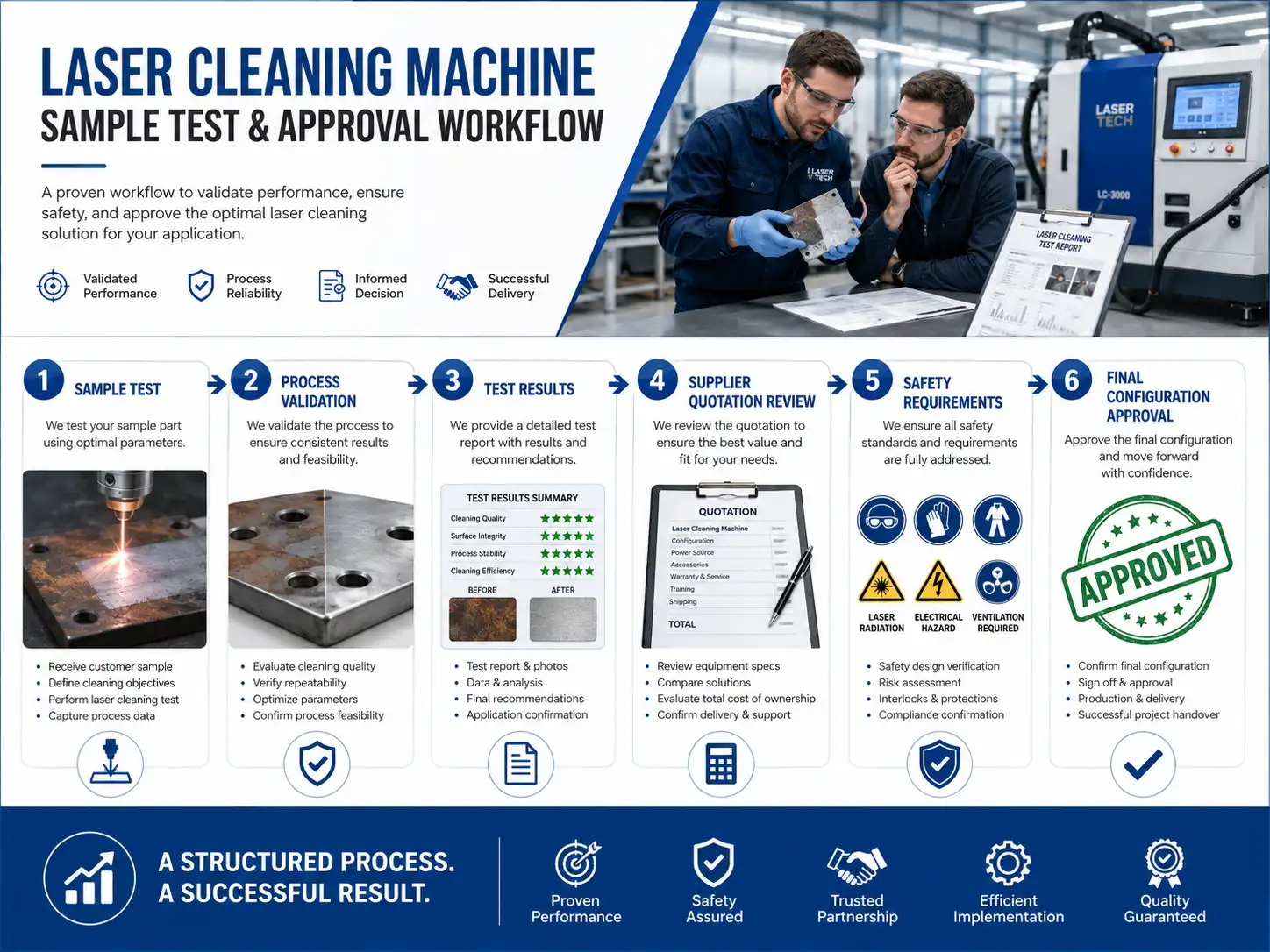
Define the Sample and Pass/Fail Criteria
Provide a representative part or coupon. State the substrate, contaminant or coating, thickness, area, geometry, current method, target rate, downstream process, allowable surface change, and inspection method. Include difficult zones.
Record Process Settings and Cleaning Results
Record the machine, source, head, cooling and extraction, scan pattern, working distance, settings, passes, cleaning time, and inspection result. Photograph with consistent lighting and scale. Retain the sample as an approval reference.
|
Test input |
Evidence to request |
Acceptance decision |
|
Substrate and contaminant |
Material identification and sample photos |
Sample represents production parts |
|
Area, geometry, and target rate |
Timed run and handling method |
Accepted output meets the required cycle |
|
Allowable surface change |
Settings, temperature data, inspection |
Result stays within the stated limit |
|
Safety and extraction |
Tested configuration and control documents |
Site team can complete its risk assessment |
|
Production format |
Handheld method or automation concept |
Path, access, and repeatability suit the job |
Evaluate the Machine, Documentation, Training, and Service Scope
Match the quotation to the tested configuration. Confirm the source, head, cooling, extraction interface, controls, fixtures, guarding, spares, manuals, training, commissioning, warranty, and response process. Identify every change from the trial machine.
Conclusion: Build the Purchase Decision Around a Sample Test
A laser cleaning machine purchase should begin with a representative sample and written acceptance criteria. That process connects source type, delivery format, cleaning rate, surface condition, safety controls, and cost to the actual production task.
WISECUT lists the WT-C1000/C1500/C2000 handheld model family, a continuous-wave handheld laser cleaning machine, and a pulsed product route. To prepare a machine review, contact WISECUT with your cleaning sample and provide the substrate, contaminant, coating thickness if known, area, geometry, throughput target, allowable surface change, inspection method, production format, and destination market. Confirm the returned model, test scope, safety documents, training, warranty, lead time, and commercial terms before purchase.
FAQ
Q1: Do laser cleaning machines really remove rust and paint?
A: Yes, a suitable laser process can remove rust and paint when the contaminant, substrate, settings, scan path, and extraction setup form a validated process. Ask for a timed test on the actual material and inspect the cleaned surface against written pass/fail criteria.
Q2: Should you choose a pulsed or continuous-wave laser cleaning machine?
A: Choose through an application test. CW systems are commonly evaluated for larger, rate-focused work, while pulsed systems provide pulse controls for selective and precision-focused trials. Compare accepted cleaning rate, heat input, final surface condition, equipment format, and total quoted scope.
Q3: Can laser cleaning change or damage the base material?
A: The base material can change when energy input, focus, overlap, travel speed, or repeated passes exceed the acceptable process window. Define the permitted temperature, finish, profile, dimensions, or metallurgical condition, then inspect the sample with a suitable method.
Q4: What safety and fume-extraction controls does a laser cleaning machine need?
A: Controls come from the machine classification, process materials, installation, and local rules. A competent risk assessment should address beam enclosure or barriers, interlocks, controlled access, eye and skin protection, local extraction, filtration, fire risk, residue handling, training, and emergency procedures.
Q5: What information should you send a supplier before buying a laser cleaning machine?
A: Send the substrate grade, contaminant or coating, thickness, cleaning area, geometry, current process, required rate, allowable surface change, inspection method, production format, destination, and site constraints. Request a recorded sample test and a quotation tied to the tested configuration.


