

How to Choose a Laser Cleaning Machine: A 7-Step Buying Guide
Time : Aug 28, 2026 View : 260
To choose a laser cleaning machine, define the substrate, contamination, accepted surface condition, cleaning area, required output, and production environment. Then compare CW and pulsed sources on a representative sample, choose the delivery format, review safety and extraction, and issue the same RFQ scope to each supplier. Approve the machine configuration that produced the accepted test result.
Step 1: Define What the Laser Cleaning Machine Must Remove
Your requirement sheet controls every comparison. It should describe the actual part and required result.
Identify the Substrate and Contamination
State the substrate grade and current surface condition. Identify rust, oxide, paint, coating, oil, weld discoloration, or mixed residue. Add coating chemistry, thickness, layers, and adhesion when known. Include photos with scale and mark difficult areas such as pits, seams, curves, recesses, and edges.
Set the Required Surface Condition
Describe the downstream operation and its acceptance method. Welding, coating, bonding, inspection, and restoration can require different surface conditions. Suitable checks may include visual criteria, magnified inspection, wipe tests, surface-profile measurement, adhesion testing, temperature records, or dimensional inspection. Set a measurable limit for allowable surface change.
Describe the Part Geometry and Production Volume
Record dimensions, cleaning area, access, handling, parts per shift, cycle time, and batch variation. These inputs determine the required motion control.
Step 2: Choose Between CW and Pulsed Laser Cleaning
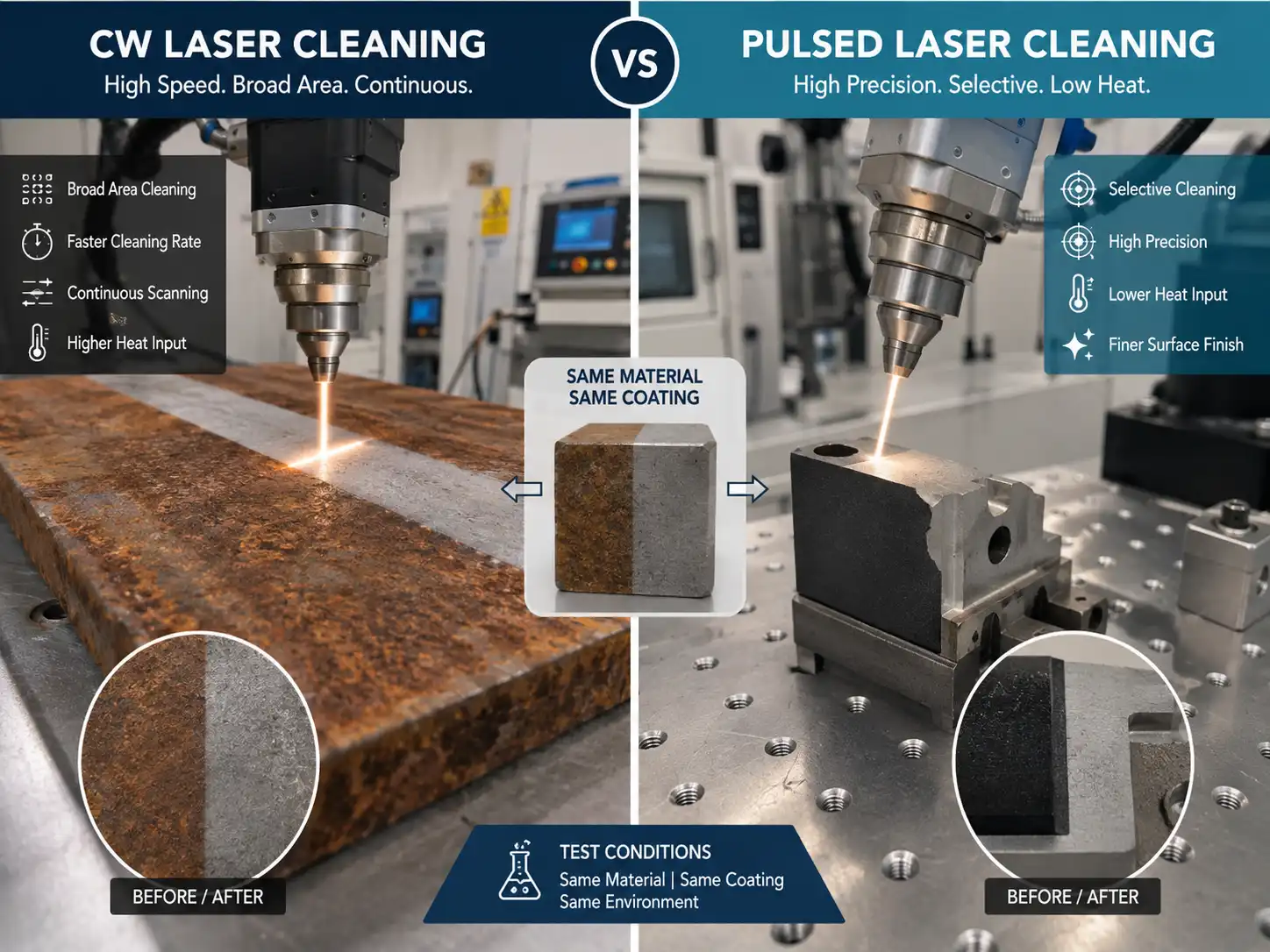
The source choice should follow the application test. Average power alone cannot describe coating selectivity, heat input, cycle time, or final surface condition.
When to Evaluate a CW Source
A continuous-wave source delivers a steady beam and is commonly evaluated for larger areas and rate-focused work. Measure accepted cleaning rate, substrate temperature, passes, final condition, and relevant dimensional or metallurgical limits.
When to Evaluate a Pulsed Source
A pulsed source delivers energy in discrete pulses and provides controls such as pulse energy, pulse width, and frequency. It suits trials involving selective removal, localized work, or tightly defined surface limits. WISECUT lists a pulse laser cleaning machine, and its knowledge base identifies a Pulse Cleaner for precision cleaning and accurate positioning.
How to Compare Both Sources on the Same Sample
Use samples from the same material and contamination batch. Apply the same acceptance method and record time, passes, settings, relevant temperature, and inspection results.
|
Decision factor |
CW trial |
Pulsed trial |
|
Main test objective |
Accepted output over a larger area |
Selective or precision-focused result |
|
Process evidence |
Time, temperature, passes, inspection |
Pulse settings, time, passes, inspection |
|
Surface decision |
Verify the stated finish and change limit |
Verify selectivity and change limit |
|
Purchase input |
Tested source, head, cooling, and controls |
Tested source, head, cooling, and controls |
Step 3: Select Handheld, Portable, or Automated Delivery
Delivery format controls access, motion, repeatability, fixtures, and operator workload. WISECUT’s knowledge base identifies handheld and automatic cleaning, while its website provides a category for handheld laser cleaning machines.
Handheld and Portable Work
Handheld equipment suits varied parts, repair work, and mobile operators. Evaluate head weight, cable routing, working distance, reach, controls, cooling, transport, extraction placement, and path consistency.
Fixed, Robotic, and Conveyor Cleaning
Automation suits repeated paths, controlled cycles, fixtures, and material handling. Define part location, motion envelope, signals, guarding, monitoring, reject handling, and line interfaces. Reproduce the intended path during testing.
Step 4: Size the Process Through a Sample Test
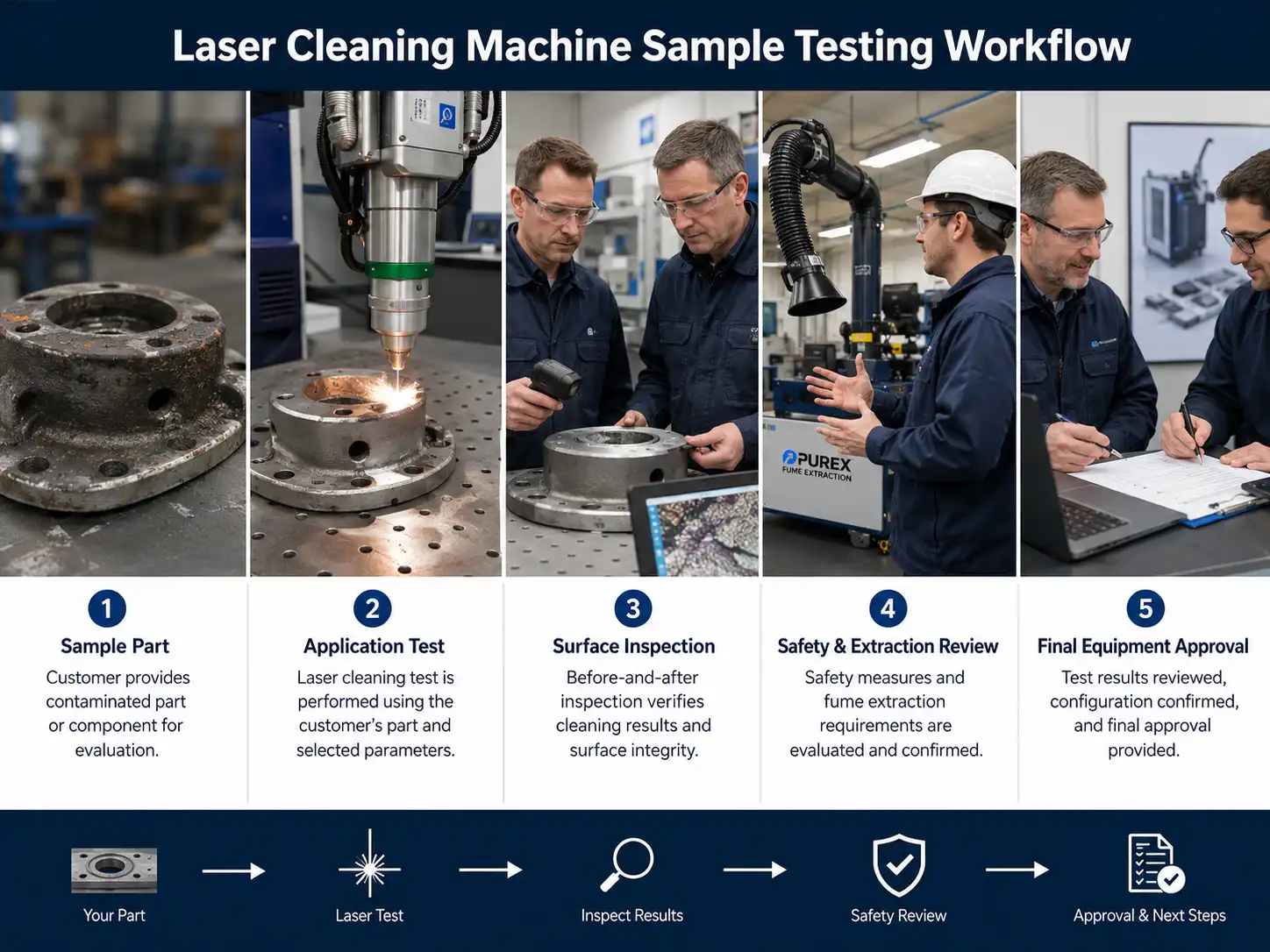
A sample test connects the machine specification to the production result. It also gives buyer and supplier a shared reference for acceptance.
Build a Representative Test Sample
Supply a production part or coupon with the correct substrate, contamination, coating thickness, geometry, and difficult zones. State the area, target output, downstream operation, allowable surface change, inspection, and normal production variation.
Record Settings, Cleaning Time, and Inspection Results
Record the machine, source, head, cooling, extraction, working distance, scan pattern, settings, passes, cleaning time, and inspection result. Use consistent lighting and scale for photographs. Retain the approved sample as a production reference.
Approve a Process Window and Tested Configuration
A process window defines settings and conditions that meet acceptance criteria. Repeat the test across representative variation and record the allowed range. Identify every difference between the test machine and quoted unit.
Step 5: Review Safety, Extraction, and Site Requirements
Safety controls belong in the machine and installation scope. Review guarding, extraction, utilities, and training before commercial approval.
Request the Machine Safety File
Request the laser classification, risk information, manuals, drawings, safety controls, interlock logic, protective-equipment guidance, maintenance instructions, and applicable declarations. The site assessment should define controlled access, barriers or enclosure, warnings, emergencies, and procedures.
Define Plume Extraction and Residue Handling
Laser cleaning can release airborne material from contamination, coatings, oils, and substrate. Identify the materials, place extraction near the process, and select filtration through a competent assessment. Include fire risk, hot particles, filter maintenance, collected residue, and local disposal requirements.
Check Utilities, Layout, and Local Compliance
Confirm electrical supply, cooling, ventilation, floor space, access, ambient limits, cable routing, material handling, and extraction discharge. Map the installation to the destination country’s workplace, electrical, environmental, and laser-safety requirements.
Step 6: Compare Total Cost and Supplier Support
Compare the complete production scope and cost per accepted part or area.
Compare Accepted Output and Operating Inputs
Use the sample record to estimate accepted output per shift. Include setup, repositioning, inspection, extraction maintenance, utilities, consumable filters, planned maintenance, and rework. Apply the same calculation period and production assumptions to every option.
Align Training, Commissioning, Warranty, and Service Scope
Record installation, commissioning, operator and maintenance training, supplied documents, support process, warranty, exclusions, spare parts, software access, and update terms. Current WISECUT terms require a formal quotation.
Build a Like-for-Like RFQ
Issue one RFQ covering the source, head, controls, cooling, cables, extraction interface, automation, fixtures, guarding, documentation, training, commissioning, spares, shipping, trade terms, warranty, and service. Separate line items make each proposal easier to reconcile with the tested configuration.
Step 7: Approve the Machine That Matches the Test
Purchase approval should bind the application, test record, quotation, and acceptance plan to one configuration.
Reconcile the Test Record and Final Quotation
Check the source model, cleaning head, controls, cooling, cables, extraction, accessories, software, and safety functions. Ask the supplier to explain any substitution and repeat relevant tests when a change can affect the result.
Document Configuration Changes Before Purchase
Use a written change record for components, settings, interfaces, utilities, documents, delivery scope, or commercial terms. Assign approval responsibility to the buyer and supplier. This record protects the acceptance baseline.
Confirm Acceptance, Delivery, and Training Records
Define factory or site acceptance checks, required samples, measurement methods, records, attendees, and correction process. List packing, shipping, installation, training, manuals, backups, certificates, and handover records in the purchase documents.
Conclusion: How to Choose a Laser Cleaning Machine with Test Evidence
Machine selection begins with a written application and ends with a quotation tied to accepted test evidence. This sequence connects source type, delivery format, safety controls, production output, support, and cost to the same part and acceptance standard.
WISECUT lists the WT-C1000/C1500/C2000 handheld family and a pulsed product route. To start a technical review, send WISECUT your cleaning application with the substrate, contamination, coating thickness, area, geometry, required output, allowable surface change, inspection method, production format, utilities, destination, and requested documents. Confirm the test scope, model, safety file, training, warranty, lead time, and commercial terms in the returned proposal.
FAQ
Q1: What is the first factor when choosing a laser cleaning machine?
A: Start with the substrate, contamination, and accepted surface condition. Add geometry, area, target output, downstream process, and inspection method before comparing source type or power.
Q2: Should you choose a pulsed or CW laser cleaning machine?
A: Choose through a controlled sample comparison. Measure accepted cleaning rate, heat input where relevant, passes, settings, and final surface condition under the same acceptance criteria.
Q3: How much laser power do you need for cleaning?
A: Required power depends on the material pair, area, coating or corrosion, scan process, accepted result, and output target. Ask the supplier to establish a process window on a representative sample and identify the exact tested source.
Q4: What should a laser cleaning machine sample test include?
A: Include the production substrate, representative contamination, difficult geometry, required area, target output, surface-change limit, and inspection method. The report should record the full machine configuration, process settings, time, passes, and results.
Q5: Which documents should you request before buying a laser cleaning machine?
A: Request the quotation, configuration list, test report, manuals, drawings, safety file, applicable declarations, training and commissioning scope, warranty, service process, spare-parts list, delivery plan, and acceptance procedure.


