

How to Reduce Labor Costs in Sheet Metal Cutting
Time : Oct 23, 2026 Visualizzazione : 11
The quickest way to reduce labor costs in sheet metal cutting is to find where operators spend time between accepted parts. Cutting may take only part of a job. Preparing programs, moving sheets, removing cut parts, checking quality, and repeating failed work all consume paid hours.
Start with a measured baseline for a representative mix of orders. Then address recurring manual work through clearer job preparation, better material flow, and equipment that fits your production volume. A faster cutter helps only when its speed reduces the labor hours needed to deliver usable parts.
Measure Labor Hours per Accepted Part
Record labor across the complete cutting job before choosing an improvement. Include everyone who prepares, runs, or finishes that job, including an operator who tends more than one machine. Keep machine running time separate from hands-on time so you can see whether the constraint is cutting capacity or labor.
Map Operator Time Across the Job
For several typical orders, record the minutes spent on drawing checks, programming, sheet retrieval, loading, changeovers, unloading, part identification, inspection, and rework. Note the material, thickness, sheet size, batch quantity, and shift. An unusually difficult order should remain visible in the data, but it should not represent the entire factory.
Count interruptions as well. A short wait for a sheet, a missing program, or an unclear part label may repeat dozens of times during a shift. Observe where an operator must stay near the machine and where work can be prepared while it cuts.
Calculate a Comparable Baseline
Use this measure for each part family or order type:
Labor cost per accepted part = total allocated labor hours x fully burdened hourly labor cost / accepted parts.
Fully burdened cost can include wages, payroll charges, and benefits according to your accounting method. Accepted parts exclude scrap and parts that still need rework. If an operator shares time between machines, allocate the time actually spent on each job. Record the allocation rule and use it consistently.
For example, a hypothetical job using 12 labor hours to produce 100 accepted parts requires 0.12 labor hour per accepted part. At an illustrative 3 in direct labor per accepted part. Compare future runs with similar materials, geometry, quantities, and inspection requirements. A lower figure caused by a simpler order does not demonstrate a process improvement.
Remove Avoidable Setup and Programming Work
Job preparation is often the least expensive place to start. Standardize the information sent to programming: the approved drawing revision, material grade and thickness, required edge condition, quantity, and part identification method. Resolve missing details before the machine is scheduled.
Group compatible jobs when delivery dates permit. Reusing a material and thickness can reduce changeovers, while a reviewed program library avoids repeating routine setup work. Nesting software can improve sheet use and cutting sequence, but the layout must leave parts practical to remove and identify. A densely packed nest can shift work from programming to sorting.
Check the first part against the drawing before releasing a long run. Track how often programs require correction at the machine and why. If many orders are prototypes or change every week, a flexible setup process may save more labor than a dedicated handling system. Shops comparing machine formats can review fiber laser cutting machine options alongside their actual part mix and available floor space.
Reduce Waiting Between Cutting Cycles
Measure what happens after a sheet finishes cutting. The operator may need to clear parts and scrap, bring in the next sheet, and confirm the next program while the machine stands idle. A revised staging layout can shorten travel and prevent searches for stock or tools. Labels and job-based bins also help keep parts together for the next operation.
An exchange table allows one platform to be prepared while the other is used for cutting. This can shorten the interval between sheets when loading and removal fit within the cutting cycle. It does not automatically eliminate the operator’s work: finished parts and scrap still need handling, and short cutting cycles may leave too little time to prepare the next sheet.
Ask a supplier to demonstrate a complete cycle with your sheet size and part layout. Time the cut, platform exchange, removal, and next load separately. WiseCut’s exchange-table fiber laser cutting machine is one configuration to evaluate when repeated sheet changeovers are limiting throughput. Use the measured cycle to estimate labor demand as well as machine utilization.
Automate Sheet Loading Where Volume Justifies It
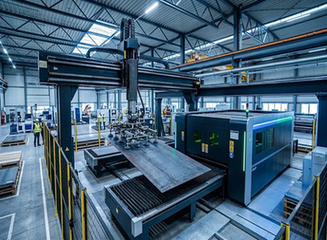
Automated handling is most useful when operators repeatedly lift or move similar sheets, especially across long batches or multiple shifts. Identify the exact tasks the system will take over. Loading, unloading, and sheet supply have different equipment requirements; a machine that loads raw stock may still leave parts to be sorted by hand.
WiseCut’s sistema automatico di carico fogli combines a truss robot, vacuum pickup, a two-level electric exchange trolley, and CNC and vacuum controls. The published configuration supports automatic and manual operating modes. These details make it relevant to a factory that spends substantial time moving raw sheets and clearing cut material.
Check the stock before estimating savings. Confirm sheet dimensions, thickness, weight, surface condition, stack height, and the range of materials used every week. Review the proposed layout for sheet storage, forklift access, extraction, maintenance clearance, and safe recovery from a fault. Ask for a trial using your thinnest, heaviest, and most difficult regular sheets.
The WiseCut product information notes that oily or adhering sheets may need manual assistance with separation. Include this possibility in staffing and cycle-time estimates. Also establish how finished parts, skeletons, and scrap will be separated after unloading. A reliable loader can reduce repetitive handling while leaving a valuable role for an operator in supervision, sorting, and quality control.
Protect Savings From Rework and Downtime
A process that produces more parts per hour can still consume more labor when operators must clean edges, inspect defects, or remake parts. Record first-pass yield beside labor hours. For recurring faults, identify whether the cause is material variation, a worn consumable, the program, cutting parameters, or handling after the cut.
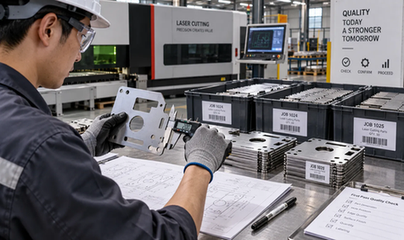
Define the inspection standard for each part family. Check dimensions and edge condition on the first piece, then set an inspection frequency that fits the process and customer requirement. Consistent part labels reduce the time spent identifying blanks after cutting and prevent the wrong part from moving to bending or welding.
Plan maintenance and operator training as part of the labor calculation. A machine stopped for an avoidable fault can leave both the operator and downstream work waiting. WiseCut describes training, remote technical support, spare-parts supply, and on-site assistance on its pagina di servizio. Confirm the response process, costs, and available support for your country and quoted machine before including those services in a payback estimate.
Compare Improvements With a Payback Check
Rank proposed changes by the labor they can remove from your measured jobs. A revised program handoff may require little investment. An exchange table or loading system needs equipment, installation, floor space, maintenance, and training. Include the remaining operator tasks in each scenario.
For a simple comparison, calculate annual labor savings = verified hours saved per job x expected annual jobs x fully burdened hourly cost. Add any documented reduction in scrap or overtime separately. Then subtract added maintenance and operating costs. Divide the installed investment by the estimated annual net savings for a simple payback period. This is a planning measure, so test it with a conservative production volume and a realistic rate of manual intervention.
Request a timed demonstration using representative drawings and stock. Ask the supplier to show loading, cutting, unloading, alarm recovery, and the next-job changeover. Record who performs each action. WiseCut offers sheet cutting and automated loading configurations; you can send your production requirements to obtain a proposed layout and scope for comparison with your baseline.
Domande frequenti
Q1: How do you calculate labor cost per cut sheet?
Una: Add the allocated labor hours for programming, handling, operation, inspection, and rework for the job. Multiply by your fully burdened hourly cost and divide by accepted sheets or parts. Keep the unit consistent when comparing jobs.
Q2: Does an exchange table reduce operator hours?
Una: It can reduce time spent waiting between sheets when the next platform can be prepared during cutting. Measure the complete cycle and the operator’s active work; the table still requires parts and scrap to be cleared.
Q3: When does automatic loading make financial sense?
Una: It deserves evaluation when repeated sheet handling consumes substantial labor across regular production. Compare verified hours saved with installation, maintenance, training, and any manual assistance the material may require.
Q4: Can a laser cutting machine run without an operator?
Una: The answer depends on the complete cell, material condition, safety controls, fault recovery, and how parts and scrap are removed. An automatic loader alone does not establish unattended operation.
Q5: What data should I collect before requesting a quote?
Una: Provide regular and maximum sheet dimensions, material grades and thicknesses, representative drawings, batch sizes, annual volume, current cycle times, labor hours, floor layout, and required finished-part quality.


