

Tube and Profile Laser Cutting Machine Guide for Industrial Buyers
Time : Sep 04, 2026 View : 228
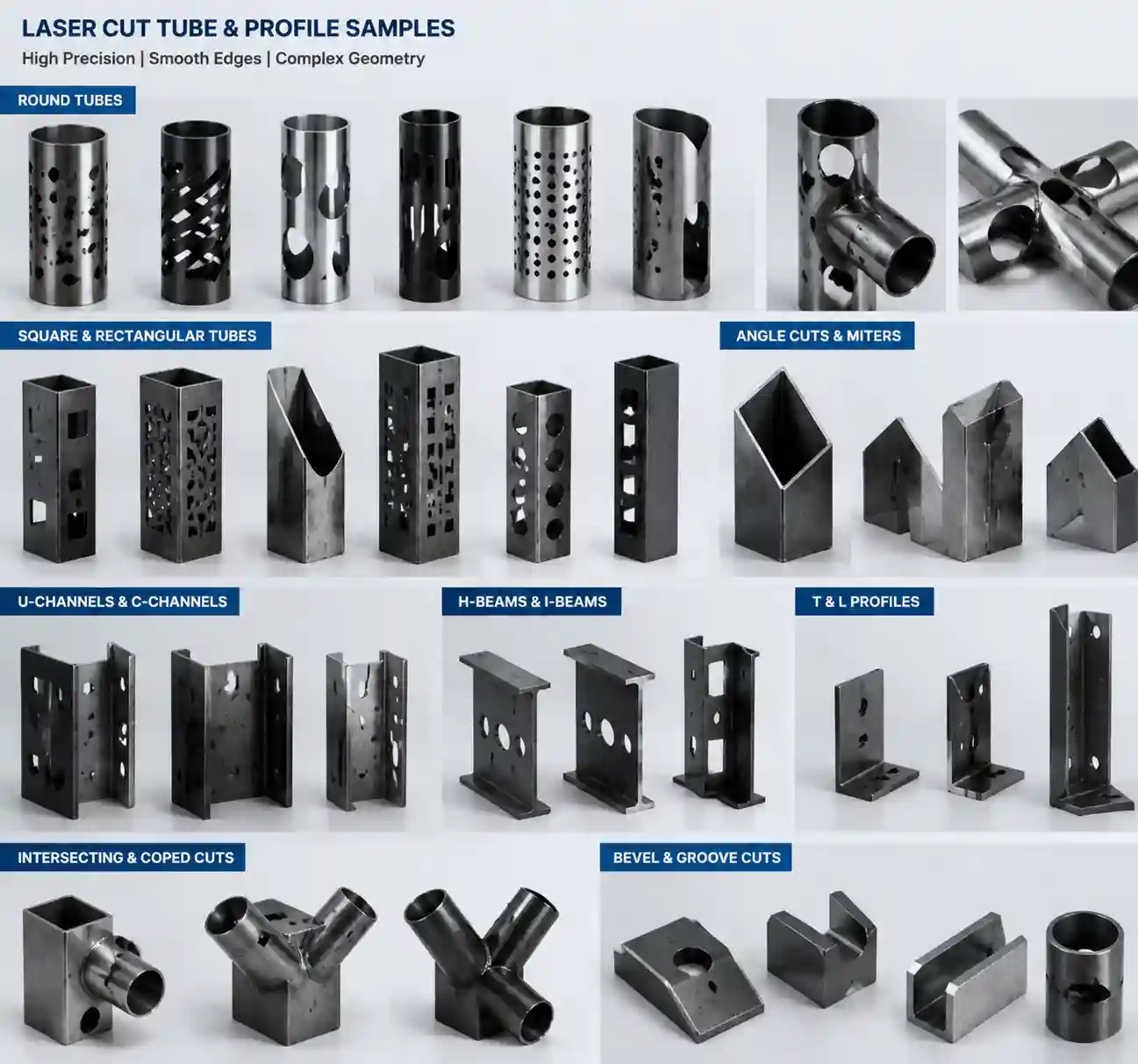
Choosing a tube and profile laser cutting machine starts with the parts you plan to cut. Define material grade, wall thickness, cross-section, stock length, part weight, cut geometry, batch size, and downstream fit-up before you compare brands or laser power. Those inputs tell a supplier which chuck structure, support system, cutting head, loading method, software, and acceptance test belong in the offer.
img.Laser cut tube and profile samples including round pipes, square tubes, and structural channels.webp
What Is a Tube and Profile Laser Cutting Machine?
A tube and profile laser cutting machine clamps metal stock, rotates it under CNC control, supports the length, and cuts holes, slots, mitres, copes, and end profiles with a fiber laser. The usable range comes from the chuck design, support rollers, cutting head, software, and loading system. Round, square, rectangular, oval, channel, angle, H-beam, and special profiles need different grip and orientation checks. WISECUT groups its tube fiber laser cutting machines into two-chuck, three-chuck, and four-chuck product routes, so buyers can compare the machine family before requesting a model sheet.
Which Part Requirements Should You Define First?
Start with a part-based specification. Power matters, yet it cannot replace tube diameter, wall thickness, weight, feature position, or welding fit-up. Send the supplier drawings and a representative tube list, then ask for a model, fixture, software, and sample-test plan that matches those parts. For profile work, include a 3D model or marked tube view when joints depend on rotation angle. State whether cut ends go straight to welding, machining, coating, or assembly, because each downstream step changes the acceptable burr, taper, and fit-up check.
|
Buying input |
What to specify |
Acceptance output |
|
Material and wall |
Grade, thickness range, coating, assist gas preference |
Clean edge, pierce stability, heat-affected area, burr limit |
|
Profile and stock |
Shape, outside size, stock length, straightness, part weight |
Chuck range, support method, loading route |
|
Features |
Holes, slots, mitres, copes, bevels, joint faces |
Cut path, head type, orientation control |
|
Production target |
Batch size, nesting priority, cycle-time target, downstream welding |
Sample report, repeatability record, usable remnant target |
How Do Two-, Three-, and Four-Chuck Machines Differ?
A two-chuck machine suits standard tube production when stock size, weight, and part length stay inside the quoted range. WISECUT’s WT-6023T dual-chuck tube laser cutter page lists 3-6 kW laser power, 6.0 m maximum pipe length, and a published chuck range of Phi 20-Phi 230 mm for that model. Treat those values as WT-6023T facts and confirm the current quotation, drawing, and material test before purchase.
A three-chuck layout adds support and handoff control for long or heavy profiles. WISECUT’s WT-6035T three-chuck heavy-duty tube laser cutting machine page lists 3-12 kW laser power, 12 m maximum pipe length, Phi 20-Phi 350 mm chuck range, semi-automatic loading and unloading, and bevel-cutting options for that model. Four-chuck systems usually belong in application-specific discussions where tail length, profile deformation, and clamping transition need close review.
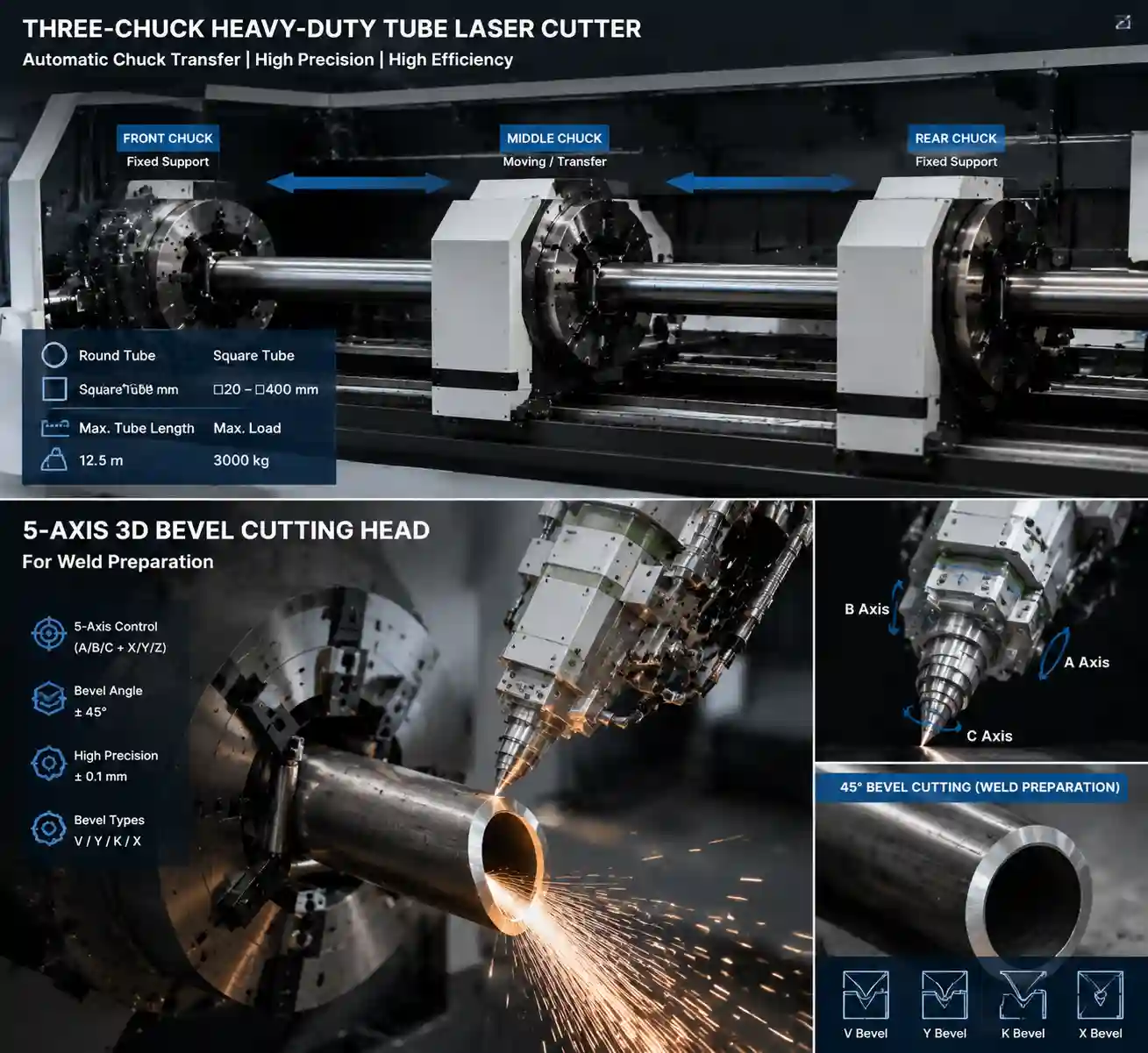
When Do You Need 2D, 3D, or Bevel Tube Cutting?
Use 2D tube cutting for perpendicular holes, slots, straight end cuts, and many furniture, railing, rack, and frame parts. Add 3D or bevel capability when the drawing includes angled joint faces, weld preparation, branch intersections, or cut features that must follow a changing tube surface. Ask the supplier to show the same geometry on the intended tube shape. For trusses, shelving, fitness equipment, furniture frames, and other special profiles, include orientation marks, weld sequence, and assembly gauges in the sample plan.
What Automation and Software Features Affect Production?
Automation affects labor, material flow, and repeatability. Manual loading fits varied jobs and small batches. Semi-automatic or automatic loading helps when long stock, repeated profiles, or heavy batches occupy the machine for many shifts. Software should import the required drawing files, nest tube parts, control chuck motion, manage remnant use, and store production data. For high-mix work, ask how long profile changes, nest reloads, and interrupted-job recovery take. For repeat production, ask which records can be exported for shift review. Ask which functions come with the base package and which require options, licenses, or local language support.
What Installation and Safety Requirements Should Buyers Plan?
Plan installation around the machine footprint and the full stock-handling path. Long tubes need clear infeed and outfeed space, lifting access, straight stock storage, and a path for finished parts. Confirm floor loading, leveling, compressed air, power supply, chiller placement, extraction ducting, slag handling, and operator access with the current manual. Guards, interlocks, laser safety procedures, fire controls, and exhaust treatment must follow the supplied equipment documents and the rules in the destination country.
How Should You Run a Sample-Cut and Acceptance Test?
Choose samples that represent daily work and the hardest features. Include the thickest wall, smallest hole, tightest slot, longest part, heaviest stock, and the joint that causes the most welding or assembly concern. Record cycle time, edge condition, hole size, feature position, repeatability, remnant length, and fit-up. Photograph the sample, keep the nest file, and mark measurement points on the drawing, so supplier-to-supplier comparisons remain auditable after the demo. The official ISO 9013 thermal cutting quality classification page describes ISO 9013:2017 as a standard for geometrical product specifications and quality tolerances for thermal cuts, including laser cuts within its stated scope. Apply it when drawings or delivery conditions reference it, and confirm suitability for the exact tube or profile contract.
How Should You Compare Quotes and Suppliers?
Make every supplier quote the same machine specification. Request the stock range, chuck structure, supports, loading and unloading method, cutting head, software modules, extraction, chiller, spare parts, training, commissioning, manuals, acceptance test, warranty, service terms, and trade terms. Separate confirmed model facts from optional equipment and commercial promises. A quote with fewer details creates extra engineering work before installation, even when the headline power looks attractive.
Conclusion: Send the Supplier a Part-Based Buying Brief
The right tube and profile laser cutting machine is the configuration that holds your actual stock, cuts your drawings, and passes your acceptance test. Build the buying brief from material grades, wall thicknesses, profile dimensions, stock lengths, part weights, annual volumes, difficult features, tolerance targets, destination country, and automation needs.
WISECUT BEIJING WISECUT LTD provides verified website routes for tube fiber laser cutting machines, the WT-6023T dual-chuck model, the WT-6035T three-chuck heavy-duty model, and special-shaped pipe/profile solutions. Send WISECUT the part files and acceptance goals so the returned discussion can focus on machine family, test scope, options, documentation, and quotation-stage confirmation.
FAQ
Q1: What shapes can a tube and profile laser cutting machine process?
A: It can process shapes supported by its chuck, support, head, and software package. Common candidates include round, square, rectangular, oval, channel, angle, H-beam, and special profiles, with final range confirmed by the model sheet and sample cut.
Q2: How do you choose laser power for tube and profile cutting?
A: Start with material grade, wall thickness, assist gas, edge requirement, and cycle-time target. Power selection should come from a current configuration sheet and a sample cut using the buyer’s actual tube.
Q3: What is the difference between two-, three-, and four-chuck machines?
A: Two-chuck machines handle many standard tube jobs. Three-chuck and four-chuck designs add support and transfer control for heavier, longer, or more complex profiles, so the quote should state tail length, support range, and clamping sequence.
Q4: When does a tube laser cutting machine need a 3D or bevel-cutting head?
A: It needs 3D or bevel capability when the drawing requires angled faces, weld preparation, branch joints, or cuts that follow the tube surface. Validate the feature on the intended profile before approving the machine.
Q5: What should an industrial buyer include in a tube laser cutting machine RFQ?
A: Include drawings, material grades, wall thicknesses, profile sizes, stock lengths, part weights, target volume, automation requirements, destination standards, and acceptance criteria. Ask suppliers to return the proposed model, options, sample-test plan, documents, training, warranty, and commercial terms.


