

CNC Bending Center vs Traditional Press Brake: Which Machine Fits Your Factory?
Time : Oct 29, 2026 View : 115
Choosing between a CNC Bending Center and a traditional press brake requires more than comparing machine prices. Both systems form sheet metal accurately, but they organize the work in different ways. A bending center is built around automated clamping, positioning, and repeated panel forming. A press brake uses a punch and die, with the operator usually moving and supporting the workpiece between bends.
The best choice depends on part geometry, material thickness, order volume, changeover frequency, labor, and the level of automation your factory needs. A machine that suits electrical enclosures may be a poor fit for heavy structural brackets.
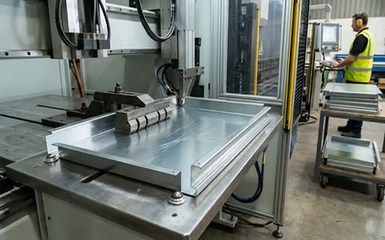
What Is a CNC Bending Center?
A CNC bending center is an automated sheet metal forming system. It normally holds a flat blank with a clamping device while motorized forming blades create flanges in sequence. Depending on the model, the machine can reposition, rotate, or reverse the blank without requiring the operator to turn it after every bend.
This workflow is common for electrical cabinets, equipment covers, HVAC panels, appliance components, shelves, and other parts with several short flanges. Programs can store bend angles, flange dimensions, orientation, and repositioning commands for repeat batches.
“CNC” describes the computer-controlled positioning and motion system. “Bending center” describes a machine architecture that combines clamping, forming, and part handling into a coordinated process. Some models also connect to automatic loading, unloading, or tool-changing equipment.
What Is a Traditional Press Brake?
A traditional press brake forms sheet metal between an upper punch and a lower V-die. The ram applies force along the bend line, while a back gauge positions the workpiece. The machine may be manual, NC-controlled, or fully CNC-controlled, so the word “traditional” should be clarified when comparing quotations.
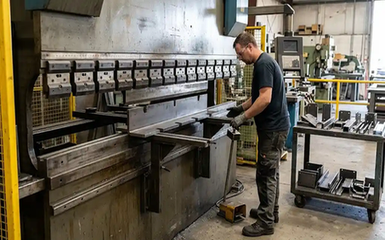
In a conventional workflow, the operator loads the blank, aligns it against the back gauge, and supports or rotates the part as the sequence continues. This requires more direct handling than many bending centers, but it gives the operator immediate control over unusual shapes, changing materials, and one-off adjustments.
Press brakes remain widely used because one machine can produce brackets, channels, plates, frames, and many custom components with a broad selection of punches and dies.
How Do the Two Bending Workflows Differ?
CNC Bending Center Workflow
The operator or an automated loader places the blank on the working table. The machine locates the sheet, clamps it, and forms the first flange with a programmed blade movement. It then repositions or rotates the blank and completes the remaining bends. The part is released after the programmed sequence has finished.
Keeping the blank controlled through more of the cycle can reduce repeated lifting, turning, and manual alignment. This is valuable when a product contains many bends or when the surface has already been coated. The main benefit is a stable, repeatable workflow for a defined product family.
Press Brake Workflow
The press brake program controls ram travel, back-gauge positions, bend order, and, on advanced systems, angle correction. The operator still places the part between the punch and die and may need to rotate or flip it for the next operation. Large panels can require front supports, cranes, or a second person.
This process is flexible. A skilled operator can change tools, adjust the sequence, compensate for material variation, and produce a new part without redesigning an automated cell. The trade-off is a greater dependence on handling skill and physical effort.
CNC Bending Center vs Traditional Press Brake: Comparison Table
|
Factor |
CNC Bending Center |
Traditional Press Brake |
|---|---|---|
|
Forming method |
Clamping and blade forming |
Punch and V-die forming |
|
Operator handling |
Lower repetitive handling |
More manual rotation and support |
|
Ideal parts |
Panels, cabinets, boxes, short flanges |
Plates, brackets, long flanges, varied parts |
|
Material range |
Thin to medium sheet, model dependent |
Medium to heavy sheet, model dependent |
|
Production volume |
Medium to high repeat production |
Prototype to medium volume |
|
Tooling |
Dedicated or specialized tooling |
Wide punch and die selection |
|
Changeover |
Efficient for repeat product families |
Flexible for mixed production |
|
Surface protection |
Less manual contact in some workflows |
Depends on tooling and handling |
|
Labor profile |
Lower repetitive handling labor |
Higher operator involvement |
|
Main strength |
Consistent automated workflow |
Broad application flexibility |
These are general tendencies. Actual capacity depends on nominal pressure, effective bending length, opening height, throat depth, stroke, tooling, software, and material properties.
Which Parts Suit a CNC Bending Center?
A CNC bending center is a strong candidate when a factory produces repeat parts with several flanges. Electrical enclosures, control cabinets, machine covers, HVAC housings, and shelving components often have predictable dimensions and a consistent bend sequence.
The technology also suits medium- and high-volume production. After programming and first-article approval, operators can run batches with limited intervention between bends.
Surface-sensitive sheet may benefit from reduced manual rotation. Fewer contact points can lower the chance of handling marks, although the result still depends on protective film, tool cleanliness, clamping pressure, and the condition of the sheet.
There are practical limits. Thick plate, heavy blanks, extra-long parts, and irregular shapes may require the force and working length of a press brake. Test these cases with actual drawings.
When Is a Traditional Press Brake the Better Fit?
A traditional press brake is often the better option for heavy plate and long bends. Its suitability depends on nominal pressure, bending length, throat depth, ram stroke, and opening height. These specifications determine whether the machine can form the material safely and achieve the required inside radius.
Press brakes are also useful for prototypes, repair parts, and high-mix job-shop work. A fabricator may process stainless steel, mild steel, and aluminum in the same day, with each job requiring different tools and bend allowances. A broad punch-and-die system allows the machine to adapt to these changes.
For many shops, one versatile press brake can cover more product categories than a specialized bending center. An experienced operator can manage unusual sequences and material variation. Review CNC press brake and bending machine options when comparing capacity and configuration.
How Should You Compare Accuracy, Speed, and Labor?
Do not compare only the machine’s rapid movement or single-bend speed. Measure the complete cycle, including loading, positioning, bending, turning, inspection, and unloading. A bending center may reduce handling time on repeated panel work, while a press brake may finish a simple bracket faster because setup is minimal.
Accuracy should be evaluated through position repeatability, bend-angle consistency, springback control, material thickness variation, tool wear, and calibration. The measurement method matters as much as the nominal specification.
For example, WiseCut’s WT-400T/4000 hydraulic CNC press brake configuration lists 4,000 kN nominal pressure, a 4,000 mm bending length, ±0.03 mm position accuracy, and ±0.02 mm repeatability. It also uses a DELEM 53T controller, servo-driven back gauge, segmented tooling, and a compensation system. These figures describe one press brake configuration; they are not universal specifications for every CNC bending center.
Labor comparison should include programming, setup, handling, inspection, and maintenance. A bending center can reduce repetitive lifting and turning, but trained staff are still required.
Tooling, Maintenance, and Operator Requirements
Bending centers commonly use dedicated or specialized tooling designed around a product family. This supports repeat production, although a major change in product design may require different tools or a new process setup.
Press brakes offer more tooling combinations. Segmented punches, V-dies, gooseneck tools, and special-radius tools can support different flange lengths, profiles, and bend radii. Tool changes may take longer, but the same machine can serve many unrelated jobs.
Maintenance depends on the machine architecture. A hydraulic press brake requires attention to oil, pumps, valves, seals, filters, guides, and electrical components. A bending center may add clamping mechanisms, forming blades, sensors, and handling parts. Confirm maintenance intervals, spare parts, diagnostics, and sheet metal machine service support.
Operator training should cover safe loading, tooling, program verification, first-piece inspection, and troubleshooting. Automation reduces some manual work, but it does not remove the need for process knowledge.
Total Cost of Ownership
The purchase price is only one part of the financial comparison. Include labor, tooling, setup, scrap, maintenance, energy, floor space, training, and downtime.
A simple model is:
Cost per Part = (Machine Cost + Labor + Tooling + Maintenance + Scrap) ÷ Qualified Parts
A bending center may justify its investment through repeat volume and lower handling labor. A press brake may offer a better return when order quantities are small or product designs change frequently. Use actual production data from representative jobs before making the decision.
Machine Selection Checklist
Before requesting a quotation, confirm:
1. Common materials and maximum thickness.
2. Maximum blank size and workpiece weight.
3. Average number of bends per part.
4. Share of cabinets, boxes, and short flanges.
5. Monthly volume and changeover frequency.
6. Surface-finish and protective-film requirements.
7. Operator availability and skill level.
8. Space for loading, unloading, and material flow.
9. Required axes, crowning, and angle measurement.
10. Training, spare parts, and service response.
Send representative drawings to the machine builder. A sound recommendation should use geometry, material data, tooling, expected cycle time, and quality requirements.
WiseCut CNC Bending Solutions
WiseCut supplies CNC press brake and sheet metal bending solutions for industrial fabrication. Configurations can be reviewed according to material, workpiece size, pressure, bending length, control system, tooling, and production workflow. Product support can include machine drawings, operator training, spare parts, and technical assistance. If the application requires a tailored comparison, request a bending machine configuration with material specifications, drawings, monthly volume, and preferred automation level.
FAQ
Q1: What is a CNC bending center?
A: It is an automated sheet metal forming system that combines clamping, positioning, bending, and, on some models, part handling. It is commonly used for panels, cabinets, boxes, and repeated short flanges.
Q2: How is a CNC bending center different from a press brake?
A: A bending center generally uses automated clamping and blade forming. A press brake forms material between a punch and die and usually requires more manual workpiece rotation.
Q3: Can a bending center process thick sheet metal?
A: That depends on rated pressure, tool design, bending length, and the machine’s approved material range. Thick or heavy material may require a high-tonnage press brake.
Q4: Does a CNC bending center reduce operator labor?
A: It can reduce repeated lifting, turning, and repositioning. Operators are still needed for loading, programming, inspection, maintenance, and production supervision.
Q5: Which machine is better for a small fabrication shop?
A: A press brake may be more practical for prototypes, repairs, heavy plate, and mixed custom work. A bending center may suit a shop producing repeat panels or enclosures in steady volume. The decision should follow actual order data.


