

CNC Press Brake Buying Guide for Sheet Metal Bending
Time : Sep 04, 2026 View : 224
When you plan to buy a CNC Press Brake, always start with the bend list in your drawing pack. Before you compare machine tonnage or controller brands for sheet metal bending, write down your key job details first. You need to list the material grade, thickness, bend length, and flange depth. Also, make sure to note the inside radius, hole positions near bend lines, tolerance, batch size, tooling, and safety requirements. A clear brief like this makes a big difference. It helps a supplier quote the right machine, tooling, training, and acceptance test that fit the exact work you plan to run.
What Is a CNC Press Brake?
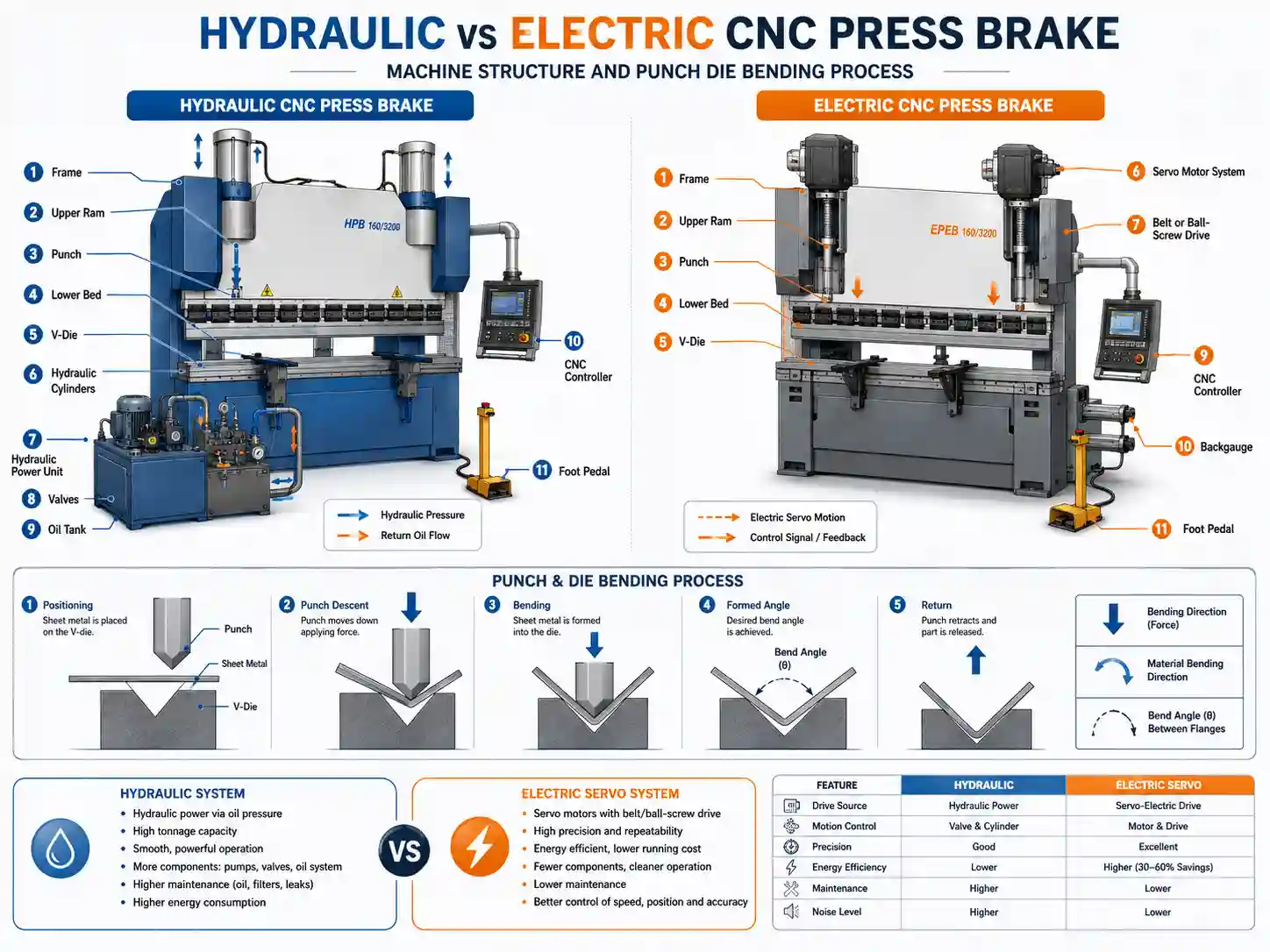
A CNC Press Brake is an automated metal-forming machine. It forces a top punch straight into a matching bottom die to create clean, accurate angles in sheet metal.
Everything runs on code.
The operator simply loads the part program and clamps the tooling. From there, the CNC system takes over the entire bend sequence. It drives the backgauge to the programmed stop position. Then the ram descends to the exact target depth. One part finishes, and the next piece drops into place with zero manual readjustment.
You see these formed components everywhere. Electrical enclosures and HVAC ducts are classic examples. But the machine is not limited to basic rectangular shapes. It also handles structural brackets, elevator panels, and tight-fitting machine covers where flange tolerances cannot slip.
Not every workshop requires the same drive system. WISECUT lists CNC Press Brake/Bending Machines across electric, hydraulic, and automated bending configurations to match specific shop demands. Heavy plate requires raw hydraulic force. On the other hand, thin, high-speed sheet runs benefit much more from all-electric servo control.
Which Sheet Metal Bending Requirements Should You Define First?
Start with the drawing pack, then add a short note on how the part moves through your workshop. The drawing should show material, thickness, bend direction, inside radius, flange size, hole-to-bend distance, cosmetic surface, and downstream assembly. A small enclosure may need narrow return flanges, gooseneck tooling, and careful bend sequencing. A long cabinet panel may need bed length, column clearance, and crowning that keeps the angle steady from left to right.
|
Buying input |
What to provide |
Supplier output to request |
|
Material and thickness |
Grade, tensile strength if known, coating, max and daily thickness |
Tonnage basis, V-die opening, bend method |
|
Part geometry |
Bend length, flange depth, boxes, return bends, hole positions |
Tooling list, clearance check, bend sequence |
|
Quality target |
Angle tolerance, flange tolerance, surface mark limit |
Sample-bend report, inspection method |
|
Production plan |
Batch size, changeover frequency, operators, workflow |
Axis count, controller, tooling storage, training scope |
How Do You Size Tonnage, Length, Stroke, Daylight, and Throat Depth?
Tonnage comes from material strength, sheet thickness, bend length, V-die opening, and forming method. Air bending, bottoming, and coining use different force levels, so a single tonnage number says little without the bend method. Ask each supplier to show the force calculation for your thickest and longest bends. Then check tool load ratings, bed loading, and concentrated-load limits.
Bending length sets the straight bend capacity. Distance between columns controls how wide a part can pass through the frame. Throat depth affects return flanges and panels that extend behind the tooling. Stroke and daylight control tool height, box depth, and part removal. These dimensions work as a set. A bed that looks long enough on paper can still create trouble when a tall box part needs to rotate out of the tools.
Should You Choose a Hydraulic, Electric, or Hybrid CNC Press Brake?
Hydraulic press brakes serve high-force jobs, thick sheets, long bends, and part families that need a heavier frame and hydraulic cylinders. Electric press brakes fit many thin-sheet and precision bending jobs where servo movement, clean operation, and repeated small-batch programs are part of the workflow. Hybrid systems combine drive technologies for selected force, speed, or energy targets.
WISECUT’s WISECUT 40TX1200MM CNC Press Brake Electric Model lists 40 tons bending pressure, 1250 mm bending length, 300 mm throat depth, 160 mm slide stroke, 420 mm daylight, 4-axis Y1/Y2/X/R control, and 0.01 mm slider repeatability for that model. WISECUT’s Hydraulic and Electric CNC Press Brake Machines page lists a WT-2541P configuration with 400 tons bending power, 4100 mm bending length, 550 mm throat depth, 5-axis Y1/Y2/X/R/V control, mechanical deflection compensation, and Delem DA-53T control content. Use those values as model-page examples and confirm the current quotation.
Which CNC Axes, Controller, Backgauge, and Crowning Features Matter?
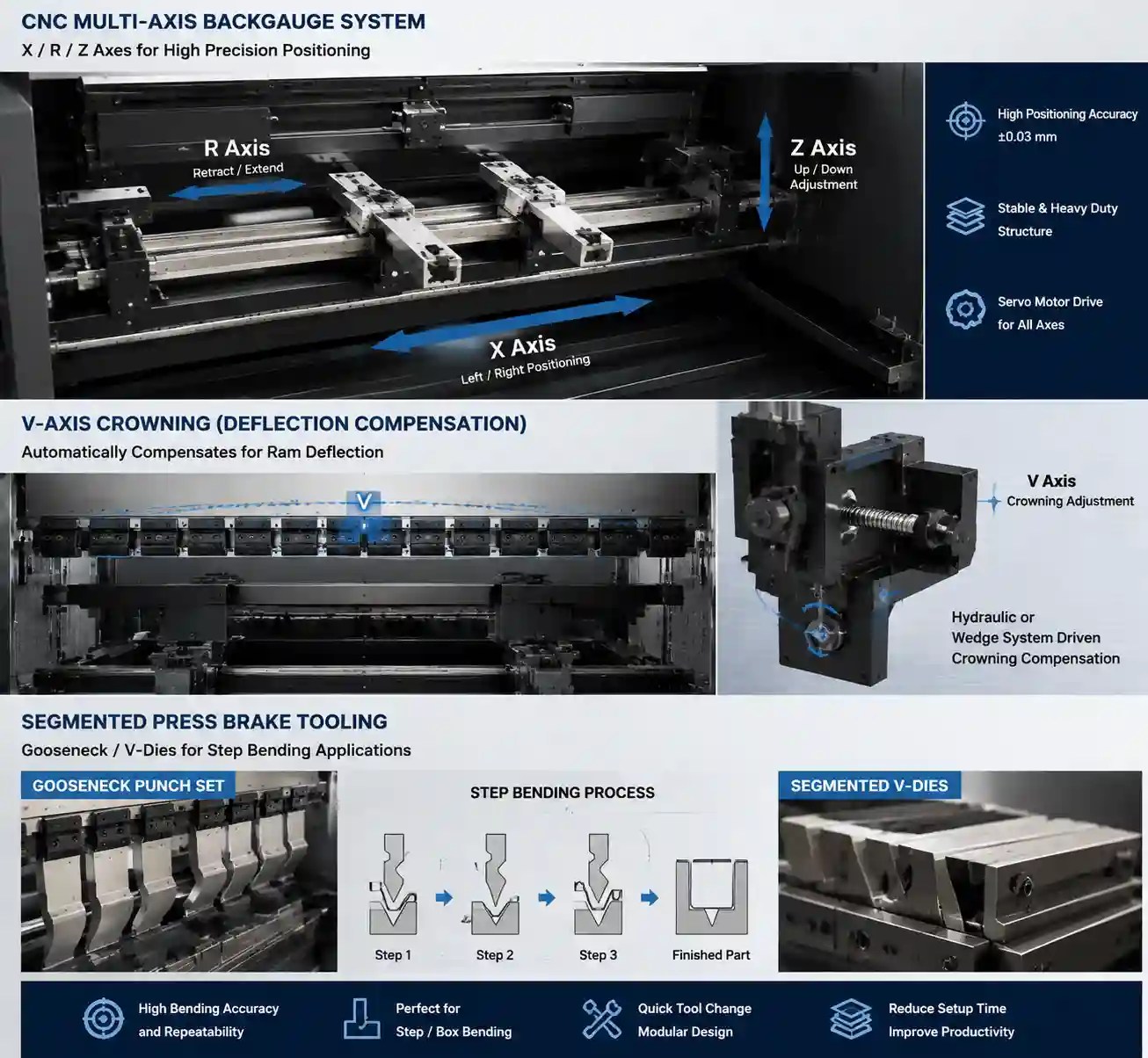
Axis count should match the part family. Y1/Y2 control manages ram synchronization. X-axis movement positions the backgauge depth. R-axis movement helps when flange heights change. Z-axis fingers support left/right positioning on mixed parts. V-axis crowning compensates for bed and ram deflection during long bends.
The controller should support the bend sequence, tool library, angle input, backgauge movement, and operator workflow your team will use. If your shop repeats enclosures, ask about saved programs, tool stations, and how operators recall a job after a shift change. If the work changes every day, ask how long a new program takes, which files can be imported, and how much training a new operator needs.
What Tooling and Clamping Package Should Be Quoted?
Tooling belongs in the machine decision. Request punches, dies, V-openings, segmented sections, gooseneck tools, hemming tools if needed, quick clamping, tool cabinets, and tool load ratings in the quote. Existing tools need a compatibility check as well. Springback, bend radius, marking, and flange clearance should be proven on a sample bend using the intended punch and die set. This is where quoting problems show up: the machine may have enough force, yet the part still needs another die opening or tool shape.
What Safety, Installation, and Workflow Requirements Should Buyers Plan?
Press brake safety planning covers guarding, light curtains or laser guarding where applicable, two-hand or foot controls, interlocks, emergency stops, operator training, lockout, tooling handling, and safe part support. ISO lists ISO 6909:2026 press brake safety standard as an international standard for press brake safety, published in May 2026, covering hydraulic, hydraulic servo-drive, screw servo-drive, and belt-spring servo-drive press brakes within its stated scope. Map any standard to the machine type, destination-country rules, risk assessment, purchase contract, and supplied manuals.
Installation planning should include unloading, floor space, power supply, hydraulic oil handling or servo-drive maintenance, tool storage, front and rear access, lighting, material carts, and space for long parts. Bending often sits between cutting and welding. Walk the material path on paper: sheet comes from cutting, reaches the press brake, turns for return flanges, then moves to welding or assembly. That sketch exposes missing space faster than a footprint drawing.
How Should You Run a Sample Bend and Acceptance Test?
Use the hardest daily parts for the sample test. Include the thickest material, longest bend, shortest flange, tightest box, cosmetic surface, and any hole near a bend line. Record tooling, V-die opening, bend sequence, springback setting, angle, flange size, left-center-right consistency, and repeatability. Mark the measurement points on the drawing and keep photos with the quote file. Later, those records make similar offers easier to compare.
How Should You Compare Quotes and Suppliers?
Build one comparable machine specification and send it to every supplier. The RFQ should ask for tonnage basis, bed length, distance between columns, throat depth, stroke, daylight, axis configuration, controller, crowning, tooling, clamping, safety devices, installation needs, documents, training, spare parts, warranty terms, service terms, destination requirements, and trade terms. Separate machine price from tooling, freight, commissioning, and optional software. Ask suppliers to label every option. A low base price becomes hard to judge when tooling, safety devices, or controller functions sit in separate notes.
Conclusion: Send a Part-Based Press Brake Buying Brief
The right CNC Press Brake is the machine package that bends your drawings with the required tooling, safety measures, inspection method, and workflow. Before purchase, align tonnage, length, axes, controller, crowning, tooling, sample-bend results, and local compliance requirements.
WISECUT BEIJING WISECUT LTD provides verified website routes for CNC Press Brake/Bending Machines, the 40TX1200MM electric model, and hydraulic/electric press brake configurations. For a configuration discussion, send material grades, thickness range, bend lengths, drawings, bend radius, tolerance, production volume, workshop layout, voltage, tooling needs, and acceptance criteria. Confirm the final model, options, commercial terms, and documentation in the returned quotation.
FAQ
Q1: How do you choose the right CNC Press Brake for sheet metal bending?
A: Choose it from the part list and bending workflow. Define material, thickness, bend length, geometry, tolerance, tooling, volume, safety requirements, and shop layout before comparing models.
Q2: How much tonnage does a CNC Press Brake need?
A: Tonnage depends on material strength, thickness, bend length, V-die opening, and forming method. Ask the supplier to calculate the force for your drawings and check the tooling load rating.
Q3: What is the difference between hydraulic and electric press brakes?
A: Hydraulic press brakes suit many high-force and long-bend applications. Electric press brakes fit many precision sheet metal jobs where servo drive, clean operation, and repeatable movement match the part family.
Q4: Which CNC axes and backgauge features matter most?
A: Y1/Y2, X, R, Z, and V-axis functions matter when parts need controlled ram synchronization, changing flange heights, varied backgauge positions, and long-bend crowning. The required axis package should follow your drawings.
Q5: What should an industrial buyer include in a CNC Press Brake RFQ?
A: Include drawings, material grades, thicknesses, bend lengths, bend radius, tolerances, production volume, tooling needs, safety requirements, destination rules, and acceptance tests. Request a returned configuration with model, controller, axes, tooling, documents, training, warranty, service, and trade terms.


