

Sheet Metal Laser Cutting Machine Guide for Industrial Fabrication
Time : Oct 02, 2026 View : 268
A sheet metal laser cutting machine sits at the start of many fabrication lines. What happens there follows the part through bending, welding, coating, and final assembly. Poor edge quality adds grinding. Inaccurate holes make forming and assembly harder. Slow sheet changes leave an expensive machine idle.
Choosing a machine starts with current factory work. List the metal grades, usual thicknesses, sheet sizes, batch quantities, tolerances, and finish requirements. These details set the production target for power, table design, automation, utilities, and acceptance tests.
What Is Sheet Metal Laser Cutting?
The machine follows a programmed path and focuses a laser beam onto a narrow area of the sheet. The metal melts or, when oxygen is used, reacts with the cutting gas. Gas flowing through the nozzle clears material from the kerf. A height-control system keeps the cutting head at the correct distance as it travels over the sheet.
Fiber lasers fit well into CNC systems and process many conductive metals. Changing the CAD file introduces a new part geometry with little mechanical setup, which suits job shops, prototypes, and mixed batches.
Which Metals Can a Fiber Laser Cutting Machine Process?
Grade, thickness, surface condition, reflectivity, and thermal conductivity change how a sheet cuts. Select the gas, nozzle, focus, speed, and laser source for the job.
Carbon Steel
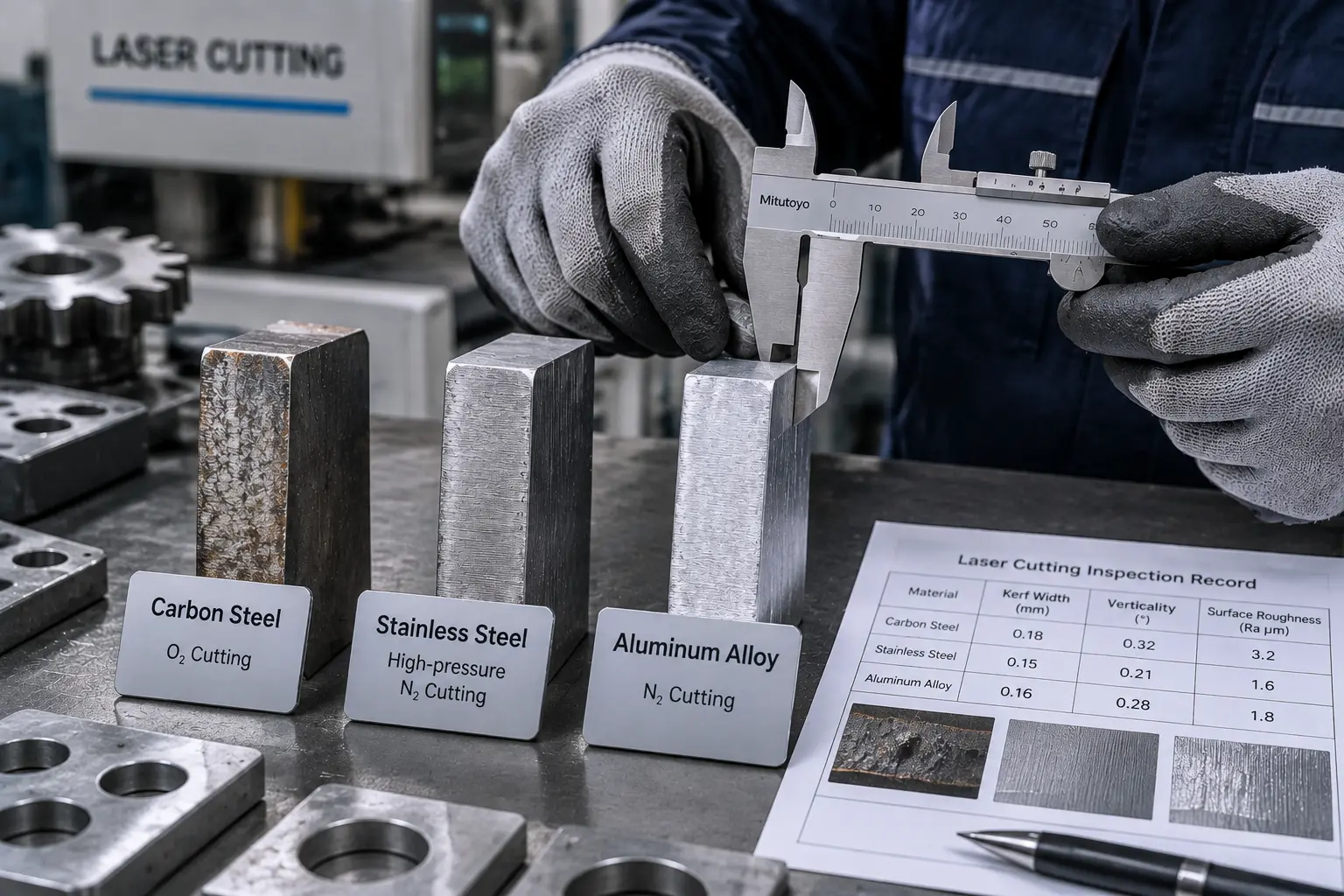
Carbon steel is commonly cut with oxygen or nitrogen. Oxygen contributes heat through an exothermic reaction and can increase speed on thicker sections, while leaving an oxidized edge. Nitrogen suits jobs that need a clean edge for welding, coating, or finishing. The next production step often decides the gas.
Stainless Steel
High-pressure nitrogen is often used for an oxide-free stainless steel edge. Gas consumption rises with thickness and can account for a large share of cutting cost. During a test, record pressure, flow, speed, burr, and discoloration across the full edge.
Aluminum, Brass, and Copper
These reflective metals need a compatible laser source and stable settings. Test the actual alloy and thickness, paying close attention to pierce points, small holes, corners, the lower edge, and the protective window.
Galvanized and Coated Sheet
Coatings affect both the cut and the air around the machine. Plan for effective extraction, material-specific settings, and the precautions stated in the material safety data. Local ventilation rules also apply.
How Do You Choose the Right Laser Power?
Use brochure charts to narrow the field, then build a thickness profile from real orders. Record the workload in each material and thickness band, the target cycle time, and the edge condition required downstream.
An occasional thick plate can distort the choice. Outsourcing rare heavy jobs may cost less than sizing the machine around them.
Confirm the final choice with witnessed cutting tests. Supply the material and a nested file with typical contours, holes, corners, and pierces. Run repeated parts and record cycle time, gas use, rejects, dimensions, and edge condition. Compare this production setting with the quotation.
Beam quality, autofocus range, acceleration, gas delivery, cooling, nozzle condition, and parameter control also change output. Compare complete configurations under the specified production conditions.
What Machine Size and Structure Fit Your Production?
Working area should cover incoming sheets and the largest regular parts. Bigger beds can improve nesting and remove repositioning, while requiring more floor space and longer handling distances. The sheet metal fiber laser cutting machine range shows the main flat-sheet structures.
Single-Platform Machines
A single table follows a simple load, cut, clear, and reload routine. It suits mixed work, modest volume, and limited floor space, although the laser stops during sheet changes. WiseCut’s single-platform laser cutting machine has a 1,550 x 3,050 mm working area in the WT3015 configuration.
Exchange-Table Machines
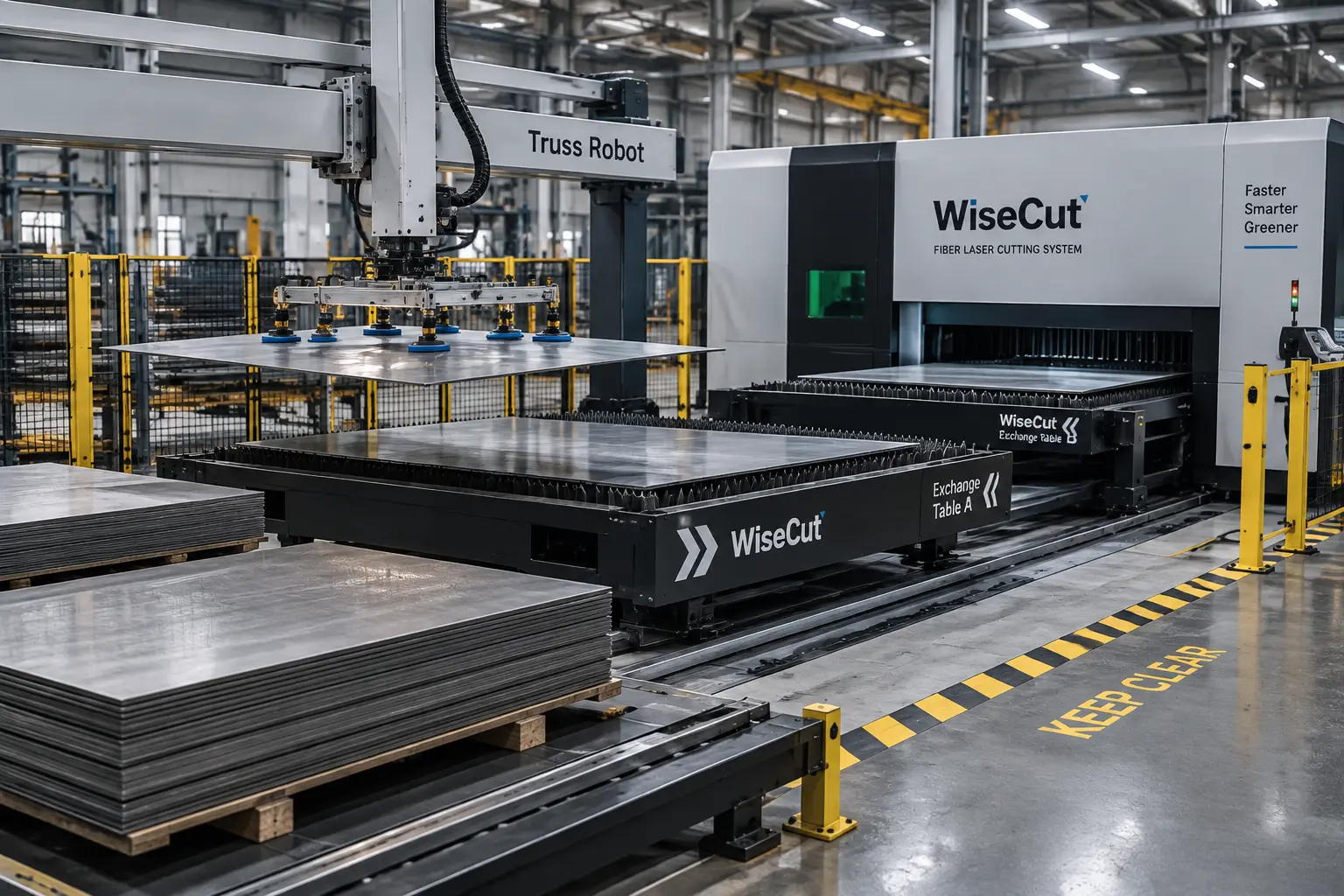
An exchange table lets the operator clear or load one platform while the other is inside the machine. Measure current changeover time first. Short savings add up across a long shift; low-volume shops may use the second table only occasionally.
Enclosed and Large-Format Machines
A full enclosure helps contain laser radiation and fumes when paired with interlocks and extraction. Large-format beds handle long plates and oversize parts. Check delivery access, foundations, crane reach, scrap removal, and service space early.
When Does Automation Make Financial Sense?
Track loading, unloading, sorting, and sheet-separation time for several shifts. The record shows how much cutting time an exchange table or automatic system could recover.
The automatic sheet loading system from WiseCut uses a truss robot, a double-layer electric exchange trolley, CNC control, and vacuum control. The listed range runs from 1,200 x 1,000 mm to 4,000 x 2,000 mm, with sheet thickness from 0.8 to 20 mm and a maximum sheet weight of 1,300 kg. Oil and sheet adhesion can interfere with separation, so difficult stacks may still need an operator’s help.
Calculate the investment from handling minutes saved, operator allocation, utilization, and accepted sheets per shift. Include the ergonomic risk of moving heavy plates.
What Determines Cut Quality?
Inspect the whole edge and difficult features. Check dimensions, repeatability, burr, dross, striation, oxidation, corners, holes, and heat distortion at several positions across the table.
Record focus, nozzle alignment, gas pressure, feed rate, piercing method, lens condition, and sheet flatness. Approved settings give operators a baseline for troubleshooting.
What Does a Sheet Metal Laser Cutting Machine Cost to Operate?
The purchase price covers power, table size, cutting head, CNC system, enclosure, extraction, cooling, and handling. Add freight, duties, installation, training, foundations, and utility upgrades to calculate delivered cost.
Operating costs include electricity, cutting gas, compressed air, nozzles, protective windows, filters, cooling maintenance, service, and operator time. Material yield and secondary finishing belong in the same calculation. Faster cutting may cost more per accepted part when it consumes extra gas or leaves an edge that needs grinding. Compare proposals by output per shift and cost per accepted part.
What Installation and Safety Requirements Should You Check?
Confirm voltage, connected load, grounding, gas supply, air quality, chiller needs, extraction, ambient limits, and foundation loading. Draw the full footprint, including table movement, open doors, loading zones, service access, and scrap removal.
The safety specification should cover guarding, interlocks, emergency stops, viewing windows, warning labels, access control, exhaust, operator training, and maintenance procedures. Check these items against the regulations that apply at the installation site. ISO 11553-1 covers laser radiation hazards and the safety information manufacturers supply with laser processing machines.
How Should You Evaluate a Supplier and Accept the Machine?
Request the configuration, layout, utilities, foundation requirements, maintenance intervals, consumables, warranty terms, and service process. The quotation should identify standard equipment, options, and power-specific components.
Use customer files and materials for acceptance. Set measurable limits for dimensions and edge condition, then run enough parts to show repeatability. Record cutting time, gas settings, alarms, rejects, and operator intervention. The contract should assign the test location, materials, gases, and response to a failed result.
For an overseas installation, confirm who handles commissioning, what language is used for training, how remote support works, when an engineer can travel, and which spare parts are stocked.
Building a Complete Sheet Metal Fabrication Workflow
Cutting decisions show up again during bending and welding. Hole position, bend allowance, grain direction, tabs, and edge oxidation affect later work. Review each blank against forming capacity and tooling before releasing the nest.
The WiseCut WT-400T/4000 press brake, for example, is listed with a 4,000 mm bending length, 4,000 kN nominal force, CNC back-gauge control, and segmented tooling. A blank that exceeds the available bending length or needs unsuitable tooling will stop the job after cutting, when material and machine time have already been spent.
Sheet Metal Laser Cutting Machine Selection Checklist
Put the following information into the request for quotation:
- Material grades and normal thickness ranges
- Standard sheets and the largest regular part
- Tolerances and acceptable edge condition
- Required output per shift
- Available cutting gases and compressed air
- Table, enclosure, and automation requirements
- Floor space, power, cooling, extraction, and foundation conditions
- Cutting, piercing, and repeatability tests
- Installation, training, warranty, software, and spare-parts terms
Using the same production brief for every supplier makes quotations easier to compare and exposes missing items before the contract is signed.
WiseCut Options for Industrial Fabrication
WiseCut supplies flat-sheet fiber laser cutters in single-platform, exchange-table, enclosed, large-format, and automatic loading configurations. Its range also includes CNC press brakes. Services include customized machine drawings, remote technical support, operator training, and spare-parts supply. Buyers can discuss cutting requirements by sending material grades, thicknesses, sheet size, volume, edge requirements, and factory utilities.
FAQ
Q1: What laser power is suitable for sheet metal cutting?
A: Base the choice on the materials and thicknesses processed most often, along with the required speed and edge condition. Supplier charts help with initial screening. Repeated test cuts on production material provide the final check.
Q2: Which assist gas should be used for carbon steel, stainless steel, and aluminum?
A: Oxygen is commonly used for carbon steel when speed on thicker material is the priority. Nitrogen is common for stainless steel and aluminum when the job calls for an oxide-free edge. Thickness, finish, gas cost, and the next production step should guide the selection.
Q3: What is the most common working size for a sheet metal laser cutting machine?
A: A working area around 1,500 x 3,000 mm fits many standard sheet formats. Larger stock and parts may call for 4,000 x 2,000 mm, 6,000 x 2,500 mm, or a custom bed.
Q4: When should a factory choose an exchange table or automatic loading system?
A: Add handling capacity when sheet changes limit output, plates are difficult to move safely, or the schedule calls for longer unattended periods. Use handling time and additional accepted parts per shift to calculate the return.
Q5: What should buyers test before accepting a fiber laser cutting machine?
A: Test normal materials, thicknesses, part features, table positions, and repeated cycles. Record dimensions, edge condition, piercing, cycle time, gas settings, alarms, and manual intervention. Every acceptance limit should appear in the purchase contract.


